Rain/Wind Backscatter Model
This study explores the influence of rain on sea wind data, revealing that approximately 4% of SeaWinds data is affected. A backscatter model is developed using collocated TRMM PR and QuikSCAT data, focusing on how radar signals are scattered by falling droplets. It categorizes three wind/rain regimes: Dominant rain affecting wind estimates, a combined influence on retrieval, and minimal rain effects, which aids in validating and correcting wind-based rain estimates globally. The implications of these findings are illustrated through specific storm examples, enhancing our understanding of atmospheric interactions.

Rain/Wind Backscatter Model
E N D
Presentation Transcript
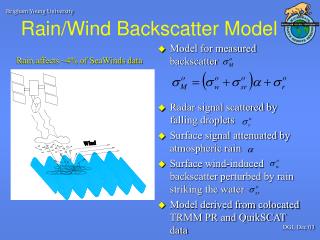
Rain/Wind Backscatter Model Rain affects ~4% of SeaWinds data • Model for measured backscatter • Radar signal scattered by falling droplets • Surface signal attenuated by atmospheric rain • Surface wind-induced backscatter perturbed by rain striking the water • Model derived from colocated TRMM PR and QuikSCAT data
Wind Rain Regimes • incorporates surface rain perturbation, atmospheric rain scattering, and attenuation - Empirical function of rain rate derived from collocated QuikSCAT and TRMM PR • Regime 1: rain dominates wind backscatter – poor quality wind estimates (10% of rain cases*) • Regime 2: both wind and rain important – can retrieve wind and rain rate (34% of rain cases*) • Regime 3: rain effects insignificant – wind estimates unaffected by rain (56% of rain cases*) • Note: globally, only about 4% of all QuikSCAT data effected by rain * From collocated TRMM PR and QuikSCAT data in tropics
Scatterometer Rain Retrieval Validation Bias can be estimated and corrected for
Rain Estimate Validation • QuikSCAT-derived rain rates vs TMI-derived rain rates