Understanding Photosynthesis: The Process and Site of Food Production in Plants
140 likes | 261 Vues
Photosynthesis is a vital process in which plants convert sunlight into food using chlorophyll. This occurs in chloroplasts, specialized organelles found in green plants, algae, and euglena. Chloroplasts contain a double membrane and structures like thylakoids (where light energy is captured) stacked into grana, all suspended in a fluid called stroma. Key pigments, primarily chlorophyll-a and chlorophyll-b, play a significant role by absorbing specific wavelengths of light, allowing plants to transform carbon dioxide and water into glucose and oxygen.


Understanding Photosynthesis: The Process and Site of Food Production in Plants
E N D
Presentation Transcript
Photosynthesis Where in the leaf does it happen?
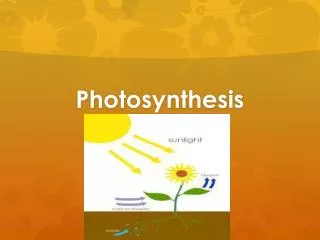
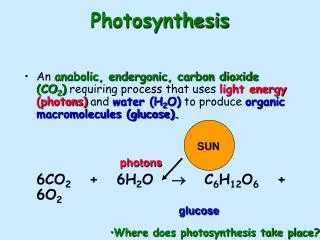
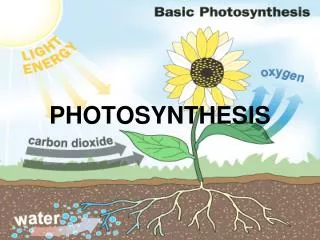
Photosynthesis! • Plants make food by the process called photosynthesis. It is a process by which chlorophyll uses the light energy from the sun to convert CO2 & H20 into glucose & O2. • Photosynthesis occurs in unique organelles of plant cells CHLOROPLASTS! • Anatomy of the Chloroplast Let’s draw it
Please Label on your sheet! • Are the site of photosynthesis • Found in green plants, algae & euglena • Football shaped • Contain green pigment Outer Membrane Inner Membrane Granum (stack of thyllakoids) Thyllakoid Stroma (fluid filled)
Chloroplast Anatomy It contains: A) Double membrane which functions to: • Support the organelle (encloses it) • Allow nutrients in. • Allow products to flow out. B) Contains light-capturing sacs called Thyllakoids (contain CHLOROPHYLL) C) Stacks of thyllakoids Granum
D) Stroma – 1) liquid region granum float in 2) contain numerous enzymes needed for the reaction 3) Dark reaction occurs here! 4) Dark reaction = Glucose maker!
The Role of Pigments in Photosynthesis! • Light is captured by PIGMENTS • The pigments can ABSORB or REFLECT light • Leaves appear GREEN because green light is REFLECTED to your eye. • What colour is a plant at night? • ROYGBIV ROY & BIV are absorbed, G is reflected
Photons Photons – a packet of light energy Each photon corresponds to a small unit of energy of a particular wavelength Photons with short wavelengths have high energy and those with long wavelengths have low energy Do Questions #1 and 2 pg. 181
The Role of Chlorophyll Chlorophyll absorbs photons from solar energy and begins the process of photosynthesis Chlorophyll a (blue-green) and chlorophyll b (yellow-green) are the two most common
Chlorophyll a is the only pigment that can transfer the energy from sunlight to the reactions of photosynthesis. Chlorophyll b acts as an accessory pigment, absorbing photons that chlorophyll a absorbs poorly or not at all. Carotenoids also act as accessory pigments Do Questions 3-4 pg. 182
3 Plant Pigments: A) Chlorophyll (Appears GREEN) * Absorbs ROY & BIV, Reflect or Transmits G B) Carotene (Appears RED) * Absorbs GBIV, Reflect or Transmits ROY C) Anthocyanin (Appears RED, Purple or Blue) *** Green is the major pigment but fades in the fall to reveal the lesser pigments red, yellow and(pg. 182)
Now What! Textbook questions: Pg. 185 #1-3