Download

1 / 15
160 likes | 769 Vues
Asexual reproduction involves a single parent organism producing offspring genetically identical to itself. In prokaryotic organisms, this occurs through processes such as binary fission, while eukaryotic organisms utilize mitosis for growth and cell repair. A variety of asexual reproduction methods exist, including budding (as seen in hydra), spore formation (mold and fungi), and regeneration (in sea stars and lizards). Additionally, both natural and artificial vegetative reproduction techniques, such as cuttings and grafting, allow for rapid and efficient plant propagation, producing clones of the parent plant.

E N D
Asexual reproduction Topic Two
Asexual reproduction- one parent creates a new organism, or offspring
Offspringof PROKARYOTIC organisms will have hereditary material that is identicalto the parent • EUKARYOTIC organisms use mitosis (sexual reproduction) to producenewfunctioning cells • Eukaryotic organisms need this process for the growth and repair of cells
Binary Fissionis equal division • Simplest form of asexual reproduction • Occurs when the organism does not have a nucleus • Genetic material is copied and the organism divides • Examples…bacteria, protozoa, algae
Budding • Parent divides into a new organism • Grown organism eventually breaks away • Examples…sponges, hydra, worms (some)
Spore Formation • Spores (haploidcells) develop • Spores grow into a new organism • Examples… mold, fungi (mushrooms), algae
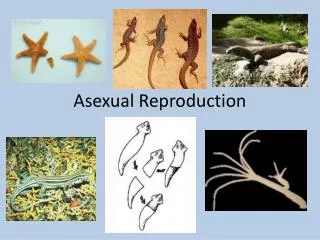
Regeneration • Regrowth of a lost body part • Examples… sea stars, lizards, some mammals (even humans?)
Natural Vegetative Reproduction • Bulbs: short underground stem surrounded by thick, fleshy leaves which stores food • Examples… tulips, onions, lilies
2. Tubers: enlarged part of an underground stem • Examples… Potato, rutabaga, yam
3. Runners: stem that grows sideways above the ground • Examples… strawberries, spider plants
Artificial Vegetative Reproduction • Cutting: uses the stem, leaf or root of a plant to produce a new individual • Stem cutting- a branch is placed in water until roots develop. Once roots develop, the cutting becomes an independent plant Examples… roses, ivy, grapevines
Grafting: stem or bud is removed from one plant and joined permanently to the stem of a closely related plant, after time the two plants grow together • Examples… lilacs, peach and avocado trees, seedless fruit
Advantages • Produces plants exactly like the parent • Development of a plant is much faster than when grown from a seed • Can obtain higher yields of fruit or nuts • Can produce seedless fruits