Asexual Reproduction
120 likes | 303 Vues
This guide provides a comprehensive overview of various asexual reproduction methods, including binary fission, budding, and spore formation. Each method is explained with details on how it works, alongside examples of organisms that reproduce this way, such as bacteria, yeast, ferns, and potatos. Additionally, common features of asexual reproduction like genetic identity among offspring and the method of mitosis are highlighted. This informative resource is designed for students studying biology and understanding the mechanisms of life.


Asexual Reproduction
E N D
Presentation Transcript
Asexual Reproduction Unit 4-1 Notes Mr. Hefti – Pulaski Biology
Binary fission • How does it work? • The organism copies its DNA then splits in half • Example organisms: • Bacteria • Paramecium • Amoeba
Budding • How does it work? • Outgrowth of cell membrane pinches off and becomes its own organism • Example organisms: • Hydra • Yeast
Spores • How does it work? • Packets of genetic information grow into new organism • Example organisms: • Ferns • Mosses • Mold • Mushrooms
Eyes on tubers • How does it work? • New plant grows out of the spud • Example organisms: • Potatoes
Runners • How does it work? • New plant grows from horizontally growing stems • Example organisms: • Strawberries • Water lilies
Bulbs • How does it work? • Underground nutrient-storage structure grows into new plant • Example organisms: • Tulips • Daffodils • Onions
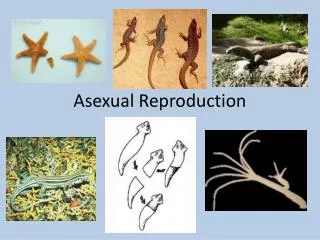
Regeneration • How does it work? • Body parts re-grow or chunks grow into new organisms • Example organisms: • Sea star • Planaria • Sponges • Lobster • AKA “fragmentation”
Common features All forms result in genetically identical offspring (unless mutation occurs) Cell division by mitosis (only) No need for Punnett squares for these organisms!
Graded Assignment • Divide sheet of paper into 4 equal sections • Examine four different slides using microscope • Provide overall title for activity • List names of group members – on the front! • In each box: • Draw diagram of specimen • List name of specimen • List magnification at which you viewed it (use your best judgment regarding appropriate power) • Label type of asexual reproduction the organism undergoes
Unit 4-1 Notes… Asexual Reproduction Name: ____________________________________________________________________ Period: ______