Understanding and Developing Use Cases for Effective System Analysis
This outline provides a comprehensive overview of use cases, essential in system analysis to identify and organize requirements. It discusses the purpose and importance of use cases within the IDESG, including levels of use cases, progress made, and future plans. It emphasizes the collaborative approach required for developing use cases, details an initial draft timeline, and highlights methods for eliciting requirements. By establishing a shared understanding of user interactions and goals, use cases guide collective efforts toward meaningful system development.


Understanding and Developing Use Cases for Effective System Analysis
E N D
Presentation Transcript
Use Case Development Cathy Tilton, Daon Scott Shorter, Electrosoft Services 7 February 2013
Outline • What is a use case • Purpose of use cases • Levels of use cases • What’s been done so far • General approach • Timeline • Workshop plans • What can be done between now and then
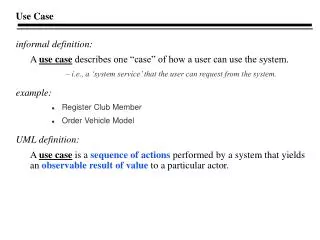
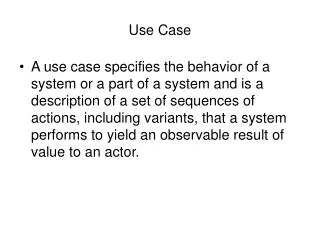
What is a use case? • Different for engineers than for business owners, users, or other species • I like this one: • a methodology used in system analysis to identify, clarify, and organize system requirements • the use case is made up of a set of possible sequences of interactions between systems and users in a particular environment and related to a particular goal
Purpose of use cases (within the IDESG) • Basis for the development of other work products – provides context • Method of eliciting requirements • Helps define the problem(s) we are trying to solve • “Determine commonalities so as to be able to design services” • Guide our collective efforts – keep us aligned
Levels • Target – “scenario” level: What & Why • Once defined, progressively lower level use cases can be derived as needed • Lower levels may have a specific focus (e.g., privacy, security, user experience,…) High Level WHY HOW Low Level (diagram inspired by Writing Effective Use Cases, Alistair Cockburn)
What has been done so far • Use case template • Draft list of potential use cases • Began to identify sources of existing use cases • Generated sample use cases • Began collection effort
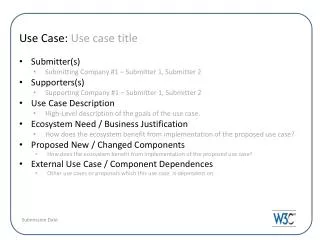
Use case template • Title & brief description • Category • Contributor • Actors • Goals • Assumptions • Requirements • Process flow • Success scenario • Error conditions • Citations
General Approach • Collection phase • Filter • Analyze and abstract • Create deliverable set (v1)
Potential collaboration process (general) Concept -> draft outline Steward ROW Wiki Existing Sources Advertise Initial/sample content Jumpstart Moderate (format, apply criteria) Contributions Expanded content Review & Comment Refined content Snapshot for Formalization (adoption) From stakeholders (including groups, workshops)
Where do use cases come from? • Existing sources • e.g., NIST, OASIS • Stakeholder (& stakeholder rep) contributions
How are they to be developed? • Multiple suggestions • AHG with online meetings • Each committee create their Top-3 • Series of joint meetings • Wiki (anyone in IDESG) • Distributed small group sessions • “Analyst group”
Timeline • Goal: Within 9 months, have an initial draft set of use cases • Near term: February March April Wiki launched Populate Wiki Wiki design Collection Filter Draft criteria Workshop NOTE: Notional – not socialized
(Proposed) May Workshop • Desired outcome: Agreed set of use cases for analysis (~10) • Review filtered set of use cases • Apply criteria • Refinements • Preconditions • Agree set of criteria • Committees, plenary members submit candidate use cases by 1 April
Needed • Criteria to be applied • Priorities • Levels • Relevance • Cross section • How? • Solicit inputs • Joint meeting (or AHG) to review & define list
Between now and then • Get Wiki setup and operational • Continue collection • Agree criteria • Detailed workshop planning • Content & process • We need you • Committees • Work with us on above • Individuals • Work with us on above