Adaptive Spatial Bandpass Filter in Computer Vision for Edge Detection
This document discusses a spatial bandpass filter commonly employed in computer vision applications to detect visual edges, which are critical for identifying the shapes of objects. It further addresses the application of a high gain inverting amplifier in the filter design, where the output voltage (Vout) exhibits a logarithmic decrease in relation to the photocurrent (Iphoto) and input voltage (Vf). By closing the feedback loop within the circuit, adaptive characteristics can be achieved, ensuring optimal performance in edge detection tasks.

Adaptive Spatial Bandpass Filter in Computer Vision for Edge Detection
E N D
Presentation Transcript
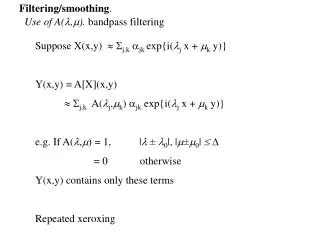
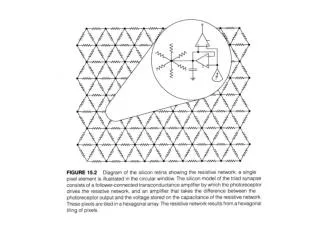
spatial bandpass filter Which is commonly used in computer vision to find visual "edges" to determine the shape of objects.
Vf Vout Iphoto High gain inverting amp Vout drops logarithmically with Iphoto Vf Vout Iphoto
C1 R Vf Vout Vp Iphoto High gain inverting amp By closing the loop, we can make this adaptive.
Vout Vp Iphoto If the loop is closed, we have our familiar circuit which has Vout =
Because the ac gain of the amplifier is very high, in practice, it is better to limit the gain using a capacitor divider. C1 R Vf Vout C2 Vp Iphoto High gain inverting amp Since Vout now does the same job of feedback through the capacitor divider,