
Uploaded by
romney
0 SLIDES
134 VUES
0LIKES
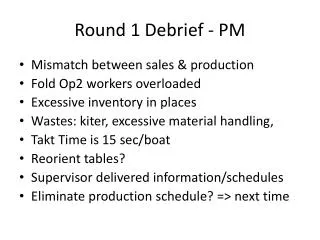
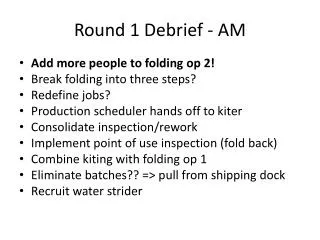
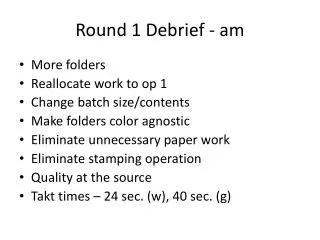
Round 1 Debrief: Operational Efficiency and Role Modification
DESCRIPTION
In this Round 1 debrief, we discuss key insights into our operations focusing on optimizing cycle times across various workstations. We target a 30-second cycle time balance, addressing each operation's needs: OP1 requires a jig for kitting and steps 1-3, OP2 manages steps 4-6, OP3 needs a template with steps 7-9 and stamping, while OP4 focuses on oven readiness. Additionally, we propose modifications to streamline our workflow by eliminating the roles of production scheduler, kitter, inspector, and reworker to enhance efficiency.
Download

1 / 0
Télécharger la présentation 
Round 1 Debrief: Operational Efficiency and Role Modification
An Image/Link below is provided (as is) to download presentation
Download Policy: Content on the Website is provided to you AS IS for your information and personal use and may not be sold / licensed / shared on other websites without getting consent from its author.
Content is provided to you AS IS for your information and personal use only.
Download presentation by click this link.
While downloading, if for some reason you are not able to download a presentation, the publisher may have deleted the file from their server.
During download, if you can't get a presentation, the file might be deleted by the publisher.
E N D
Presentation Transcript
- Round 1 Debrief - pm Balance cycle time between operations (target 30 sec) OP1 kitting + steps 1-3 need jig OP2 steps 4-6 OP3 steps 7-9 + stamp need template (limits) OP4 oven Modify roles – eliminate production scheduler, kitter, inspector, reworker Rearrange tables – one table per color; rework next to inspector and ovens Alter oven batch size (try size of 2) Use kanban cards to pull work through the factory make kanban spots Quality at the source (make jigs) Use water striders (displaced workers) Point of use storage
- Round 2 Debrief - pm Pace was much more comfortable OP2 is the bottleneck shift some work to OP1 Goal is schedule the pacemaker shipping in this case Could deliver raw material more frequently reducing inventory Consider vendor managed inventory (Boeing) Oven turned out not to be bottleneck Green oven ran larger batches White oven ran smaller batches Consider doing more inspection at OP1 & OP2 haunch (but we still need to determine exactly what to measure) Ideally kanban should communicate quality requirements, not just presence of product

















More Related