PetroSA Overview
Established in 2002, PetroSA is the owner of the world's third-largest GTL refinery, capable of producing 36,000 barrels of products per day. With 1,925 staff as of July 2013, PetroSA plays a vital role in South Africa's refining capacity, contributing 6% overall. The company operates across the full petroleum value chain, producing diesel, gasoline, kerosene, and specialty products. Strategic initiatives focus on leveraging GTL technology for growth and strengthening energy security while supporting economic and job creation in the region.

PetroSA Overview
E N D
Presentation Transcript
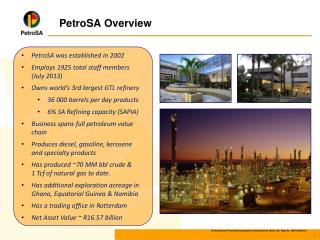
PetroSA Overview • PetroSA was established in 2002 • Employs 1925 total staff members (July 2013) • Owns world’s 3rd largest GTL refinery • 36 000 barrels per day products • 6% SA Refining capacity (SAPIA) • Business spans full petroleum value chain • Produces diesel, gasoline, kerosene and specialty products • Has produced ~70 MM bbl crude & 1 Tcf of natural gas to date. • Has additional exploration acreage in Ghana, Equatorial Guinea & Namibia • Has a trading office in Rotterdam • Net Asset Value ~ R16.57 billion * Following the merger of Soekor E & P and Mossgas Pty Ltd
Our Current Strategic focus is • Sustain the GTL refinery at Mosselbay, • Use the GTL refinery as a platform for growth, • Grow PetroSA to a significant industry player in RSA and regionally, • Contribute meaningfully to security of energy supply, • Support economic growth, job creation and drive transformation.
New Technology: LTFT Demonstration operational trials completed
ING Condensate Syngas FA platform Gas separation Methane reforming Synthol C3 Gas c4 = LNG storage C8+ synthetic oil C3 C4 C5+ oil C3 =, C5 – C7 = Imported condensate LPG Gasoline Olefin Oligomerisation Unleaded petrol Oil refining and blending Leaded petrol Distillate Illuminating Kerosine Diesel Fuel oil Reaction water Low-aromatic distillates Light alcohol Alcohol recovery Acid water to effluent treatment Heavy alcohol Mossel Bay GTL Process flowsheet
ING Condensate Syngas Syngas FA platform Gas separation Methane reforming Methane reforming LTFT Synthol C3 Gas Gas Wax c4 = LNG storage Synthetic oil C8+ synthetic oil C3 C4 C5+ oil C3 =, C5 – C7 = Imported condensate LPG LPG Gasoline Olefin Oligomerisation Unleaded petrol Oil refining and blending Hydrocracker & Hydrotreater Naphtha Leaded petrol Distillate Illuminating Kerosine Diesel Diesel Fuel oil Reaction water Reaction water Low-aromatic distillates Light alcohol Alcohol recovery Acid water to effluent treatment Acid water to effluent treatment Heavy alcohol LTFT Process flowsheet
Naphtha 25% Diesel 70% LTFT increases diesel production Low temperature Fischer-Tropsch High temperature Fischer-Tropsch LPG 1% Alcohols 9% LPG 5% Gasoline 48% Diesel & Kerosene 39% Fuel oil 3%