JRA2 Test Management Tools
The final review of the ETICS 2 project, held in Brussels on May 11, 2010, focused on significant outcomes in enhancing distributed testing services. Key objectives included developing standards for test interfaces, advanced test tool registration, and creating user-friendly workflow designer interfaces for complex test scenarios. Major achievements entailed the successful integration of various test tools and systems, fostering effective collaboration among users through intuitive plugins and robust metrics. Valuable lessons learned will inform future endeavors in testing infrastructure development.

JRA2 Test Management Tools
E N D
Presentation Transcript
JRA2Test Management Tools Eva Takacs (4D SOFT) ETICS 2 Final Review Brussels - 11 May 2010
Contents Objectives Major Achievements Metrics and Statistics Lessons learned and future work Conclusions ETICS 2 Final Review - Project Achievements - Brussels, 11 May 2010 2
Objectives ETICS 2 Final Review - Project Achievements - Brussels, 11 May 2010
Main Objective of JRA2 activityProject objective: Enhancement of the services • The main objective of the JRA2 activity is to design and implement a new approach for distributed testingby applying advanced workflow technology and distributed computing in a flexible, user friendly way ETICS 2 Final Review - Project Achievements - Brussels, 11 May 2010 4
Objective 1 • Develop the necessary test interface standards for proper collaboration with the job submission system, to provide metrics for A-QCM in well-defined formats and to provide users „readable” reports • Year 1: • definition of standards • Year 2: • provision of plugins (integrated test tools) having the proper interfaces • Integration of the Workflow Designer with Job Submission service having the proper xml format ETICS 2 Final Review - Project Achievements - Brussels, 11 May 2010 5
Objective 2 • Provideadvanced test tool registration functionalities equipped with an advanced information system- as part of the ETICS Test System –allowing users an intuitive plugins management and information center • Year 1: • Beta version having core functionalities • Year 2: • Final version with information system and intuitive registration process focusing on the usability of the system ETICS 2 Final Review - Project Achievements - Brussels, 11 May 2010 6
Objective 3 • Provide an advanced interface (Workflow Designer) for the users to construct their complex multi-node deployments scenarios and testing process in a convenient, easy of use way even for non-professional system integrators • Year 1: • Having a running instance on Sztaki’s server, defining the interfaces with other ETICS services (Job Submission) • Year 2: • Having integrated in ETICS framework, producing the well-defined output and having implemented the interpreter of the workflow ETICS 2 Final Review - Project Achievements - Brussels, 11 May 2010 7
Major Achievements ETICS 2 Final Review - Project Achievements - Brussels, 11 May 2010
ETICS Test System ETICS Test System is a portlet of the ETICS Web Portal comprised of the following elements: • Test Tool Registration System – portlet and web servicefor plugins management and information center • Workflow Designer - workflow tool and the associated services and workflow interpreter for complex, multinode test design • Collection of plugins – added test tools, third party utilities producing appropriate reports and providing data in well-defined format for further analysis ETICS 2 Final Review - Project Achievements - Brussels, 11 May 2010 9
ETICS System architectureTest System in the main architecture 10
Well-defined InterfacesObjective 1 – test interface standards ETICS Test System provides • complex test descriptions in a well-defined format – enabling the communication by job submission service in a standardised way • representation of metrics/summary metrics in the ETICS build/test reports provided by test plugins are standardised – metrics to be available for trend analysis, A-QCM ETICS 2 Final Review - Project Achievements - Brussels, 11 May 2010 11
Test Tool Registration SystemObjective 2: advanced test tool management It is a GWT based web portlet • Providing a generic web based registration, authorisation procedure for plugins/test tools, /third party utilities management • Step-by-step approach • It serves as an information center on the availability of test tools that can be applied during build/test processes for ETICS configurations • tag based search • test tool categories • Provides an authorisation mechanism for plugins administration ETICS 2 Final Review - Project Achievements - Brussels, 11 May 2010 12
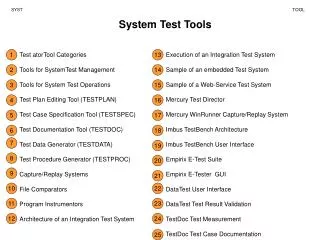
Test Tool Registration System Objective 2: advanced test tool management • Information system – test tool categories • Information system – tag based search • Addig a new plugin – step by step approach 13
Metrics - Test PluginsObjective 1,2: registered tools having standard interfaces 14
Workflow DesignerObjective 3: advanced graphical user interface for test processes • Web and Java based graphical application accessible through the ETICS Test System and using the ETICS configuration information • It serves as a high-level front-end for the command-line based multinode test mechanism • It allows multi-node test design, when the required services are deployed on different machines(the message passing between different phases of service deployment on different nodes is crucial) • ETICS web service interprets the xml output of the design through a workflow interpreter ETICS 2 Final Review - Project Achievements - Brussels, 11 May 2010 15
Workflow DesignerObjective 3: advanced graphical user interface for test processes • Configuration of the graph • Execution of the graph • ETICS configuration elements generation • Design of the graph representation 16
Testing Scenarios for ETICS Test System Taking into account technical and marketing aspects showing ETICS capabilities several testing scenarios have been created • Build process having unit tests and static analysers • Run time Web service testing with coverage extension • Deployment test of the portlet • User acceptance and browser compatibility test scenario on a local or multi-node environment ETICS 2 Final Review - Project Achievements - Brussels, 11 May 2010 17
Desktopgrid ProjectEDGeS - ETICS collaboration • The targets of theEDGeS(Enabling Desktop Grids for e-Science) project are scientific user communities that require large computing power and ready to use alternative e-Infrastructure solutions, e.g. volunteer or Desktop Grid systems. • EDGeS needs a framework like ETICS because • volunteer computer owners accept only trustable software • requires understanding of many different environments and multiple platforms • EDGes started using ETICS framework for • Building and integration of the new applications to be added into the desktopgrid environment • Validation and testing of the integrated applications focusing on platform compatibility testing and dynamic tests (Valgrind plugin) • AQCM for core Desktop Grid middleware components ETICS 2 Final Review - Project Achievements - Brussels, 11 May 2010 18
Deliverables and Milestones ETICS 2 Final Review - Project Achievements - Brussels, 11 May 2010
Deliverables ETICS 2 Final Review - Project Achievements - Brussels, 11 May 2010
Milestones ETICS 2 Final Review - Project Achievements - Brussels, 11 May 2010
Lessons learned and future work ETICS 2 Final Review - Project Achievements - Brussels, 11 May 2010
Lessons Learned • Having an environment that integrates builds and tests is more efficient than actually having separated tools • Applying high level workflow technology for the orchestration of individual but related test tasks in a distributed environment proved to be indispensible Lessons learned from the EDGeS – ETICS collaboration: • Frameworks such as ETICS have a substantial learning curve, but using it in software projects revealsthe existing technical problems easily in the early phase of the project contributing to a better final software product. ETICS 2 Final Review - Project Achievements - Brussels, 11 May 2010 23
4D SOFT’s contribution and benefits ETICS 2 Final Review - Project Achievements - Brussels, 11 May 2010
Next steps for 4D SOFTConcrete steps Continuing technical developments after the project: • Local ETICS instance installation (https://etics3.4dsoft.hu:8443/eticsPortal) • Preparing a simplified ETICS installation package for single user purposes on local macshine • authorisation • Windows compatibility 4D SOFT Customers: • First customer (robotics industry) signed with 4D SOFT and will use ETICS forsoftware engineering in C to develop avionics systems for unmanned aircraft. ETICS 2 Final Review - Project Achievements - Brussels, 11 May 2010
Conclusions The major achievement of the JRA2 activity is that it has created the possibility to have a full orchestration of large complex test cases across disconnected administrative domains. This is generally not possible to do even with high-end commercial tools and its the first open source software ETICS 2 Final Review - Project Achievements - Brussels, 11 May 2010
Thanks! http://www.eticsproject.eu