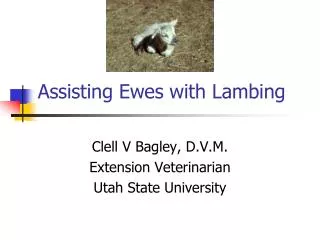
Assisting Ewes with Lambing
190 likes | 281 Vues
Discover essential tips and techniques for assisting ewes during lambing, including identifying presentations, correcting postures, and providing necessary assistance. Learn how to handle difficult births and ensure the health of both the ewe and lamb post-delivery.


Assisting Ewes with Lambing
E N D
Presentation Transcript
Assisting Ewes with Lambing Clell V Bagley, D.V.M. Extension Veterinarian Utah State University
An Important / Critical Time • Frequent observation • Extra help (with training provided)
When should I help? • Uneasy 2-3 hrs but not active straining • Abdominal straining ½ to 1 hr with little progress • Water sac / membranes evident ½ to 1 hr with little progress
Examination: Capture and Restraint • Don’t disrupt other ewes and newborn lambs • Quietly haze to catch-pen or use long sheep hook • Lay ewe down on her side which favors use of your preferred right or left hand
Vaginal Examination • Wash ewe’s rectal-vaginal area and your hands and arms • Use mild soap or shortening as lubricant • Keep fingers and hand in cone shape • Examine for presence of lamb or dilation of cervix. If not dilated, allow more time. • If dilated, consider relative size of lamb
Estimating Size and Determining if Alive • Main cause of difficult birth is oversize lamb for pelvic opening • Important time for decision to assist or get professional veterinary help • Check for life by movements, reflexes (toe pinch, sucking) or heart beat but not always evident
Identify Presentation (coming forwards or backwards) • Both are normal – don’t turn around • Identify front or rear legs by comparing joints of lamb and observing dam’s
Identify Posture (placement of feet and head) • Normal front = head and feet in diving position
Backward Presentation / Posture • Normal, if both hind feet coming together and up into vagina (“rearward” diving)
Abnormal Posture (correct before trying to pull) • Front leg(s) back
Breech (backward and feet forward under lamb) • Ewe may not show strong labor; may be prolonged and the lamb dead
Abnormal Lambs • A variety of abnormalities can occur and may require veterinary assistance
Correcting Posture • Repel the lamb back into uterus • Slow, steady push, especially between contractions • Caution not to tear uterus or stick finger through it • Cover teeth or hoof with hand, so it doesn’t cause damage • Ewe stand or elevate rear quarters
Correcting Posture (aids) • Attach a snare, small rope or o.b. chain to a leg or head that is back • Head – behind ears and inside mouth • Legs – on each leg, not both together • Breech • Pushed forward • One leg at a time • Small rope on; straighten
Traction / Pulling the Lamb • Pull slow and steady, with contractions as much as possible • If very tight, pull on one body part at t a time, with the attached rope, etc. • With hard pull, place your foot under the vulva and push against ewe’s pelvis while applying traction • Caution – don’t break lamb’s leg
Other Assistance • O.B. lubricant, mild soap or shortening applied to the lamb to reduce resistance • When the head is at the vulva, stretch the lips of the vulva back over the head of the lamb • When the head is out, clean off the face and nostrils with a towel to enable breathing when delivered
After Delivery • Be sure to check for another lamb • Clip navel and apply iodine • Squirt small strip of milk from each teat • Assist ewe to stand; leave quietly
Later • Recheck to be sure ewe and lamb are okay • Be sure lamb has nursed and received colostrum within 2 hours