Understanding German Modal Verbs: Conjugation Patterns and Sentence Structure
70 likes | 190 Vues
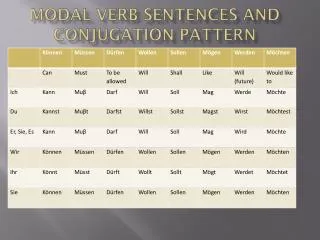
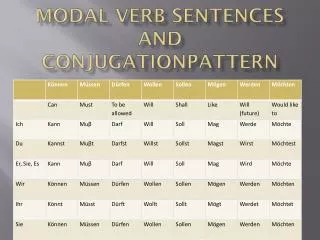
This guide explores the conjugation patterns of German modal verbs, specifically focusing on "können." You'll learn the forms for different subjects (Ich, Du, Er/Sie/Es, Wir, Ihr, Sie) and how to structure modal verb sentences. Key structures include examples like "Ich kann das Brot essen" and how to form questions such as "Kann ich das Brot essen?" Understanding these patterns will enhance your ability to communicate effectively in German, especially regarding abilities, desires, and obligations.


Understanding German Modal Verbs: Conjugation Patterns and Sentence Structure
E N D
Presentation Transcript
Pattern • IchKann • Du Kannst • Er, Sie, Es Kann • WirKönnen • IhrKönnt • SieKönnen The Ich and Er, Sie, Es are identical as are the Wir and Sie. So you need to remember to add the st and t with Du and Ihr just like you do in regular conjugation.
Modal Sentences Regular Sentence Ichesse das Brot. Modal Sentence Ich will das Brotessen. Ichsoll das Brotessen. Ichkann das Brotessen. Du willst das Brotessen. Du sollst das Brotessen. Du kannst das Brotessen. The action verb is at the end of the sentence and the only verb conjugated is the modal verb and it is next to the subject replacing the action veb.
Same basic sentence structures as before. • Ichkann das Brotessen. • Kannich das Brotessen? • Wannkannich das Brotessen? • Heutekannich das Brotessen.