Exploring the Historical and Political Context in J.M. Coetzee's "Boyhood"
90 likes | 272 Vues
J.M. Coetzee's novel "Boyhood" reflects a complex tapestry of South Africa’s historical and political landscape. The narrative is deeply influenced by the Boer Wars, the rise and fall of apartheid, and the dynamics of racial segregation. Through the lens of an Afrikaner childhood, Coetzee delves into themes of identity, ethnicity, and the fraught relationships between different racial groups. The work addresses the broader implications of colonialism and nationalism, while also providing insight into Coetzee's own background and the socio-political environment that shaped his writing.


Exploring the Historical and Political Context in J.M. Coetzee's "Boyhood"
E N D
Presentation Transcript
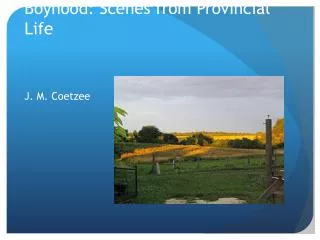
Boyhood: Scenes from Provincial Life J. M. Coetzee
Historical Context • Wars • Boer Wars (First War 1880-1881, Second War 1899-1902 ) • Fought between Britain and South African farmers (Boers) • Ended with the conversion of the Boer republics into British colonies • World War II (1939-1945) – initiated as a result of Hitler invading Poland • Axis (Germany, Italy, Japan) vs. Allies (France, Britain, US, Soviet Union) • Cold War (1945-1991) • Between the US and the USSR (Soviet Union aka Russia) • South Africa strongly anti-communist, against Russia • Apartheid (1948 – 1994) • System of racial segregation enforced through legislation by the National Party governments of South Africa • Classified inhabitants into four racial groups ("native", "white", "coloured", and "Asian"), and residential areas were segregated • Religion • Majority Christian (80% Protestant), Roman Catholic 6%, Jewish (~6%)
Political Context • Nationalist Party • Founded in 1915, governed 1948-1994 • Main support from Afrikaner farmers and intellectuals • United Party • Governed 1934-1948 • Support from different members of South African society (English-speakers, Afrikaners, Coloureds)
Racial Distinctions “There are white people and Coloured people and Natives, of whom the Natives are the lowest and most derided.” (pg. 65) • Afrikaner • White South African • Descendents of Dutch, French and German settlers during the 1500’s • Settlers became farmers and intermarried with the natives of that area • This is why white south Africans speak Afrikaans! • Coloured • Colored or mixed raced South African • Original Definition = The colored offspring of the meeting between the Dutch settlers and the natives in that area. • National Party Definition = Anybody who isn’t White or Black • Passage on pg. 61 • Natives • Passage on pg. 61
J. M. Coetzee- Biography • Born Feb. 9, 1940 in Cape Town; oldest of two sons; raised in Cape Town and Worcester • Mother- school teacher, Father- trained as attorney, served during WWII in North Africa and Italy • Studied English and Mathematics at the University of Cape Town • Worked as a computer programmer in England • Earned his Ph.D. in 1968 in English, linguistics, and Germanic languages from the University of Texas in Austin • First started writing in 1969; first novel Dusklands published in 1974
Significant Observations • The ethnicity of the narrator • Usage of the Third Person throughout the book • Mentioning of the narrator’s name only once: “Where’s John?” (pg. 103)
Discussion • Contradictions Beatings Being Normal (pg. 34 -> pg. 38) Being Afrikaner - Class Change/Language (pg. 49, 69/70 -> pg. 125) • Significance of the Sense of Distance (3rd Person) • Relationship with parents (dad – pg. 43 - 44) (mom – pg. 47 – 48)
Group Discussion • Definition of Childhood (Top of pg. 14) • Significance of the Farm (pg. 95 – 97) • Significance of Language: Words/Letter passages (Top of pg. 61, Top of pg. 91, Second to last paragraph on pg. 125)