Download
1 / 53
530 likes | 659 Vues
This lesson explores the Articles of Confederation, their weaknesses, and the reasons behind their initial design. We will discuss why the founders feared a strong central government, the events leading to the Constitutional Convention, and the key players involved, including George Washington and James Madison. Students will review significant documents such as the Declaration of Independence and the Federalist Papers while participating in activities that reinforce these concepts, including a scavenger hunt and a note-taking session.

E N D
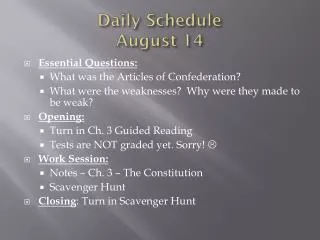
Daily Schedule August 14 • Essential Questions: • What was the Articles of Confederation? • What were the weaknesses? Why were they made to be weak? • Opening: • Turn in Ch. 3 Guided Reading • Tests are NOT graded yet. Sorry! • Work Session: • Notes – Ch. 3 – The Constitution • Scavenger Hunt • Closing: Turn in Scavenger Hunt
Road to the Constitution Ch. 2 and 3
House of Burgesses - 1619 • 22 representatives • First legislature in America • Jamestown • Able to raise taxes and make laws • Contributed to the development of a representative government .
Mayflower Compact • Ship off course and leaders realized that they were under no jurisdiction • Made everyone on board sign compact • Plymouth colony • 41 signers • “just and equal” laws • Direct democracy
Declaration of Independence • Thomas Jefferson did all of the work • Approved July 4, 1776 • Opponents: people said that it did not look at the future interests of the colonists
Articles of Confederation • First form of written government • 1781 – 1789 • By 1781 all states had ratified the A of C • Two levels of govt. that share fundamental powers • Unicameral
Articles of Confederation • Strengths • enter into treaties • coin and borrow money • declare war
Why were the A of C made weak to begin? • Colonists were just under a Monarchy so they purposefully made the Articles weak. Didn’t want a strong government?
State Legislature • New Hampshire – 1st state with constitution • Soon all 13 states adopted a constitution • Each state had a legislature, most were bicameral (2 parts) • Governors were elected by citizens or legislature.
Daily Schedule August 15 • Essential Questions: • The bundle of compromises consists of what documents? • Opening: • List 5 weaknesses of the Articles of Confederation. • Work Session: • 1. Go over the Scavenger Hunt • 2. Notes – Ch. 3 • 3. Bundle of Compromises • Closing: • Finish drawings
Constitutional Convention May 25 – September 17, 1787 Place: Carpenter’s Hall, Philadelphia Purpose: to revise the Articles of Confederation 55 delegates 12 states – all except Rhode Island
Constitutional Convention Cont. • Eventually decided to throw out articles and start from scratch • George Washington – chairperson • Ben Franklin – oldest delegate (82) • James Madison – father of the Constitution because he kept detailed records
Ratification • 1787 complete – now must get states to ratify • means to approve or accept • ¾ of states must approve • 9/13 states
Federalists • Those who support the constitution • Alexander Hamilton • John Jay • James Madison
The Federalist Papers • 85 essays written to the people of New York • Convincing them to ratify the Constitution • Written by James Madison and Alexander Hamilton
Anti-federalists • those who oppose the constitution • reasons: no bill of rights and govt. too strong without bill of rights • Thomas Jefferson • Patrick Henry
Constitution • April 30, 1789 – ratified • George Washington was sworn in as the first President.
The Constitution • Six Main Principles
Popular Sovereignty • let the people decide how they want to be governed • People have final say - EX: “We the People”
Limited Government Government is not all powerful and must operate within certain bounds of the people
Separation of Powers • National government is divided up into 3 branches • Executive • President, Vice-President and the Cabinet • Execute or enforce the laws • Legislative – • Congress (Senate and the House) • makes the laws • Judicial • headed by the U.S. Supreme Court and lower Federal Courts • interpret the law and render justice
Checks and Balances • the power of each of the 3 branches to place a check on the other 2 branches to prevent abuse of power
Federalism • the division of powers between the National Government and the states
Judicial Review • the power of the Supreme Court to review cases and declare a law Constitutional or unconstitutional. The first time to use Judicial Review was in the case of Marbury vs. Madison.
3 parts to the Constitution • Preamble • 7 Articles • 27 Amendments • It sets guidelines within which the government must operate • It has changed in the last 50 years • It is open to interpretation • It is the highest form of law in the land
Amendments • Question: How has the Constitution endured and kept up with such astounding change and growth over the years? Answer: The document is and is not the same Constitution of 1787. There are built in provisions for accommodating change.
Definitions: • Amend – to add or change • Repeal – to do away with • Amendments – changes made to the Constitution
Two ways of amending: • Legislative Branch • Formal • Informal
Formal Amendment Process • Two methods of proposing and ratifying • Proposing • Proposed by 2/3 vote in each house of Congress • Proposed at a national convention, called by Congress at the request of 2/3 of the State legislatures (34 states)
Ratifying - 3. Ratified by State legislatures in ¾ of the States. ( 38 states) 4. Ratified by conventions in ¾ of the States.
Informal Amending • Result from the daily experiences of government • 5 ways • Basic legislation • Executive Action • Court Decisions • Party Practices • Customs and Traditions
Bill of Rights • First 10 Amendments • First time the basic constitutional rights were set out for the people • Protections from the government
Daily Schedule August 21 • Essential Questions: • What are the Bill of Rights? • How many Amendments do we have in the Constitution? • Why is the Constitution considered a living document? • Opening: • Take out Bill of Rights Notes Sheet • Work Session: • Bill of Rights Notes Sheet • Amendment Project Discussion • Closing: Study for Checks and Balances Quiz tomorrow!!!
Daily Schedule August 23 • Essential Questions: • What is an Amendment? • How is the Constitution a living document? • Opening: • Take out Notes • Work Session: • Amendments 11-18 review • Amendment Project • Closing: work on projects – DUE THURSDAY!
Amendment 11 • Suits Against States • No State may be sued in a federal court by a resident of another State or a foreign country.
Amendment 12 • Election of President and Vice President • Each elector casts one ballot for President and Vice President.
Amendment 13 • Slavery and Involuntary Servitude • Forbids slavery in the U.S. and owned territories. • Forbids other forms of forced labor as well
Amendment 14 • Rights of Citizens • Defines citizenship • Contains 2 major Civil Rights Provisions • Due Process Clause – forbids a state to act in any unfair way • Equal Protection Clause – forbids a state to discriminate against persons
Amendment 15 • Right to Vote – Race, Color, Servitude • It forbids the States from discriminating against any person on the grounds (listed above) in the setting of suffrage qualifications
Amendment 16 • Federal Income Tax • Congress has the power to levy an income tax, a direct tax.
Amendment 17 • Popular Election of Senators • Senators are elected by the voters in each State.
Amendment 18 • Prohibition • Outlawed the selling, making, transporting, importing, or exporting of alcoholic beverages in the U.S.
Daily Schedule August 26 • Essential Questions: • Opening: • Work Session: • Amendments 19-27 • Amendment Project • Closing:
Amendment 19 • Equal Suffrage – Sex • No person can be denied the right to vote in any election in the U.S. on account of his or her sex.
Amendment 20 • Commencement of Terms; Sessions of Congress; Death or Disqualification of President-Elect • Pres. and V.P.- Takes office January 20th • Congress - Takes office January 3rd
Amendment 21 • Repeal of the 18th Amendment
Amendment 22 • Presidential Tenure • No President can serve more than 2 terms, not to exceed 10 years total.
Amendment 23 • Presidential Electors for the District of Columbia • D.C. gets 3 electoral votes • (1 House and 2 Senate) = 3 votes
Amendment 24 • Right to vote in Federal Elections – Tax Payment • No poll tax