Understanding the U.S. Political System: Key Terminologies and Concepts
This overview explores essential components of the American political system, including the two-party system, grassroots political support, and the roles of political parties and action committees. Key concepts such as platforms, local chairpersons, and propaganda techniques are discussed. It highlights the significance of the general election, propositions, and recalls in the electoral process. Additionally, it delves into legal terms like jurisprudence and public law, emphasizing the protection of individual rights under the Constitution.

Understanding the U.S. Political System: Key Terminologies and Concepts
E N D
Presentation Transcript
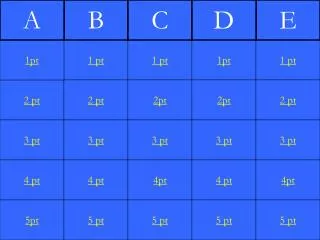
A B C D E 1pt 1 pt 1 pt 1pt 1 pt 2 pt 2 pt 2pt 2pt 2 pt 3 pt 3 pt 3 pt 3 pt 3 pt 4 pt 4 pt 4pt 4 pt 4pt 5pt 5 pt 5 pt 5 pt 5 pt
Political support at the local or neighborhood level is called this.
An association of voters with broad common interests who want to elect candidates that share their interests.
A series of statements expressing a party’s principles, beliefs, and positions on election issues.
This person controls a city, town, or county political committee.
Special interest groups that help fund a candidate’s campaign.
This allows a candidate to attack an opponent without offering a chance to respond.
Elections are a two-part process involving primaries and this.
People sign a petition to get this on a ballot in a general election.
Information given to the press to test public reaction to an idea or policy.
They provide lawmakers with tremendous amounts of information.
Radio, television, and the internet are examples of this type of media.
The Fifth Amendment states that people may not be required to do this.
Disagreements over non-criminal matters.
Rights guaranteed under Constitution are considered part of this type of law.
Given under oath to “Tell the truth, the whole truth, and nothing but the truth.”
A young person under the age of adulthood who commits a crime.
This amendment protects you against unfair treatment while you’re in jail waiting to stand trial.
An act that breaks a federal or state criminal law and causes harm to others.