Download
1 / 33
330 likes | 430 Vues
This session introduces the Mathematics at Work 10 course, a 110-hour program focusing on Measurement, Geometry, Number, and Algebra, designed to enhance critical-thinking skills for workforce or academic pathways. Explore the chapter features and student engagement strategies.

E N D
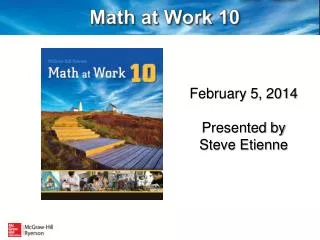
February 5, 2014 Presented by Steve Etienne
Before we begin… • If you have any questions during the presentation please post them in the chat on the left of your screen and we will spend some time during the webinar as a Q/A time. • This session will be recorded and the archive will be available within the next 2 weeks on the DVL website. http://dvl.ednet.ns.ca/browse/results/taxonomy%3A169 • If you have technical difficulties please call our help desk. • (902) 424-2450
Mathematics at Work 10 • Make sure you have a copy of the textbook with you.
Mathematics at Work 10 • 110-hour course comprised of 4 units: • Measurement (M) (40–45 hours) • Geometry (G) (45–50 hours) • Number (N) (20–25 hours) • Algebra (A) (integrated throughout)
Mathematics at Work Pathway • This pathway consists of three newly designed courses and replaces the Mathematics Foundations Pathway • These new courses are designed to provide students with the mathematical understandings and critical-thinking skills identified for direct entry into the work force or for entry into programs of study that do not require academic mathematics.
AdasdfsadfasdfaasdfasdfasdfasdfasdfasdfasdfasdfasdfasdffffffffffffffffffffffffffffffffffsdfsdfasdfasdfasdfAdasdfsadfasdfaasdfasdfasdfasdfasdfasdfasdfasdfasdfasdffffffffffffffffffffffffffffffffffsdfsdfasdfasdfasdf • Sdasf • Asd • Fasd • A
Math at Work 10 Introduction • A new resource developed specifically to support the Mathematics at Work 10 course • Focus on Atlantic contexts; vetted by educators from Eastern Canada • A philosophical approach, instructional and technical design based on extensive research of education literature and consultation with educators and students • Project-based approach, appropriate to the curriculum and the audience.
Math at Work 10 Introduction • Logical chapter sequence that begins with context and outcomes where students can experience early success, thus promoting future success • Clean, consistent design specifically targeted to this particular audience • Emphasis on contexts and applications relevant to Apprenticeship and Workplace students
Math at Work 10 Chapter Opener • Career Link • Describes a specific job or trade that makes use of the mathematics in the chapter • Introductory Visual(s) • Illustrates how the topic connects to real life • Connects to the Chapter Project • Key Words • New mathematical vocabulary introduced in the chapter • Introductory Contexts • Connects to real world • Questions designed to assess prior knowledge
Math at Work 10 Get Ready • Questions • Divided into topics • Reinforces prior skills needed for the chapter
Math at Work 10 Numbered Section Features • Focus On… • Identifies the specific outcomes in student-friendly language • Reflect • Supports reflections, critical and creative thinking • Explore • Develops conceptual understanding of the topic • Promotes active knowledge and skill acquisition • Web Link • Illustrates how the topic connects to real life
Math at Work 10 Numbered Section Features • On the Job • Develops conceptual understanding of the topic • Promotes active knowledge and skill acquisition • Tools of the Trade • Provides information about how mathematics and/or specific tools are used in a related job or trade • FYI • Provides additional context or bits of information related to the example • Your Turn • Immediate opportunity to demonstrate knowledge and understanding • Assists students in self-assessing progress
Math at Work 10 Numbered Section Features Check Your Understanding • Check Your Understanding • Appears after every On the Job feature within a section • Consists of two parts Try It and Apply It • Apply It • Provides opportunities for both conceptual and procedural understanding • Wide range of workplace contexts appealto a variety of student interests • Try It • Provides opportunities to demonstrate knowledge and comprehension • Reinforces procedural understanding
Math at Work 10 Numbered Section Features • Work With It • Occurs after all of the On the Job features are completed • Questions with entry points for all students • Provides opportunities to demonstrate conceptual understanding, consolidate learning, and make connections • Discuss It • Provides opportunities for students to apply, extend, and share their learning • Fosters metacognition and higher level reflection
Math at Work 10 End of Chapter Features • Skill Check • Self-assessment organized by section • Page references encourage students to review as needed • What You Need to Know • Encourages students to become knowledgeable managers of their learning • An opportunity for self-assessment
Math at Work 10 End of Chapter Features • Test Yourself • Provides a variety of question types: multiple choice, short answer, and extended response • May be used for self-assessment or as a study tool
Math at Work 10 End of Chapter Features • Chapter Project • Allows students to use the knowledge and skills acquired in the chapter to complete a culminating project • Clear outline provided of requirements for project completion • Games • Spatially oriented games and puzzles • Exposes students to mathematical concepts in a different context
Math at Work 10 • Teacher’s Resource • The Chapter Planning Chart conveniently summarizes suggested timing, resource and assessment options available for each section within a Chapter. • Using this chart teachers can: • Estimate Timing requirements and check to your yearly plan • Review Prerequisite Skills • Identify Materials and Technology used • Choose Blackline Masters • Look for Extra Support • Plan Assessment
Math at Work 10 • Teacher’s Resource • Chapter Support: • Chapter Foldout • What’s Ahead • Planning Notes • Meeting Student Needs • Career Link • Web Link • Chapter Project • Section Support: • Explore Notes • Common Errors • Answers • Assessment Charts • Tools of the Trade • On the Job • Work With It • Rubric Notes
Math at Work 10 • Teacher Resource • Chapter Material • Planning Notes • Explore • Meeting Student Needs – ELL/Gifted and Enriched • Answers and Assessment • On the Job • Check Your Understanding – Try it / Apply it • Work With It • Discuss it • Tools of the Trade – marginal boxes with additional information
Math at Work 10 - Online • Online Learning Centre – Teacher • Course-Wide Content Tab • Access to print Teacher Resource material in pdf format • Generic and Chapter specific BLMs in Word and PDF format format • Teacher Weblinks • Online student text to project in class • Chapter Material • Chapter Weblinks and Word Puzzles
Math at Work 10 • Exercise and Homework Book • Provides support for the Explore activity and On the Job examples • Additional practice to support key ideas • May be used in class or as additional homework support • Not to be distributed to students • Used by you as a supplemental resource
Math at Work 10 Thank You!
Questions and contact information • Eric Therrien • ICT Consultant (Mathematics & Sciences) • therrem@gov.ns.ca • (902) 424-5561 • Sharon McCready • Mathematics Support Consultant • mccreasa@gov.ns.ca • (902) 424-5196 • This session will be recorded and the archive will be available within the next 2 weeks on the DVL website. http://dvl.ednet.ns.ca/browse/results/taxonomy%3A169