Understanding the Basics of the Periodic Table: Elements, Structure, and Classifications
Dive into the essentials of the Periodic Table, focusing on the components of atoms: protons, neutrons, and electrons. Learn how to calculate atomic mass and the number of neutrons, and grasp how atomic number relates to the number of protons and electrons. Discover element classifications—including metals, non-metals, and metalloids—and their unique properties. From the reactivity of Group 1 elements to the stability of noble gases, this overview includes essential tips for mastering the table and its significance in chemistry.

Understanding the Basics of the Periodic Table: Elements, Structure, and Classifications
E N D
Presentation Transcript
October 7th Periodic Table
Protons, Neutrons, and Electrons • Atomic Number = protons & electrons • Atomic Mass = protons + neutrons • Calculate: • Neutrons = Mass – Atomic Number STAAR Tips: • APE(atomic number is the same as the amount of protons and electrons) • M&M(mass in the middle)
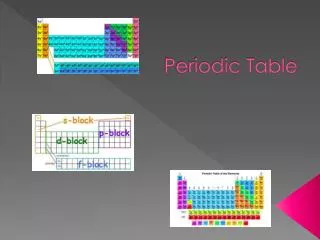
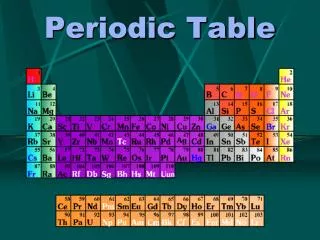
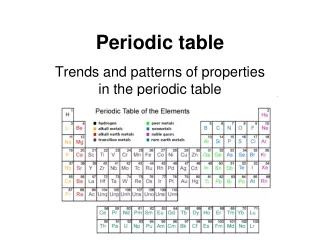
Groups & Periods • Groups (columns) • 18 groups • # of valence electrons • Skip groups 3-12 for now (transition metals) • Periods (rows) • 7 periods • # of energy orbitals for electrons
Noble Gases • Non-metals • All gases at room temperature • All of their outer most energy levels have something in common • Discover during our upcoming lab! • EXTREMELY UNREACTIVE! MOST STABLE! • Remember: helium is used in birthday balloons
Group 1 • This group is MOST REACTIVE • They have something in common in their outermost energy level
Element classifications: Metals • Metals • Most abundant If you have an unknown element, how do you know you have a metal? Shiny Magnetic Good Conductor Malleable Ductile
Element Classifications: Non-Metals • Non-Metals • Organic Elements (SPONCH) here: • Sulfur • Phosphorus • Oxygen • Nitrogen • Carbon • Hydrogen
Non-metals Continued… If you have an unknown element, how do you know you have a non-metal? Dull Brittle Not a good conductor Not magnetic Not ductile Insulators
Element Classifications: Metalloid • Metalloid • Least abundant • On the “stair case” If you have an unknown element, how do you know you have a metalloid? These have properties of BOTH metals and non-metals!