Restriction Endonucleases
This article explores the role of restriction endonucleases in DNA manipulation, essential for cloning and genetic research. It highlights their specificity for palindromic DNA sequences and how they cut DNA at precise locations. Additionally, the life cycle of bacteriophages, such as phage l, is examined, detailing the infection process and the subsequent replication of phage DNA within bacterial cells. The contributions of Nobel laureates Werner Arber, Dan Nathans, and Hamilton Smith to this field are also discussed, showcasing the significance of their work in molecular biology.

Restriction Endonucleases
E N D
Presentation Transcript
RestrictionEndonucleases • David Peterson
Information Flow in Cells DNA RNA Protein Transcription Translation
Enzymes Catalyze reactions Most are proteins
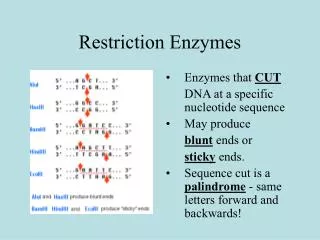
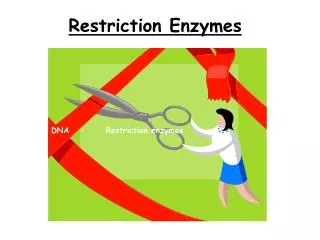
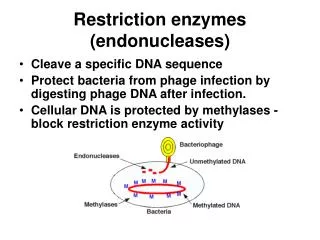
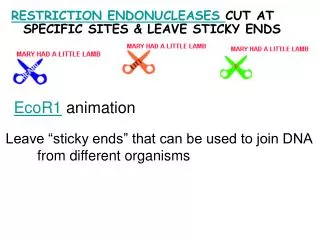
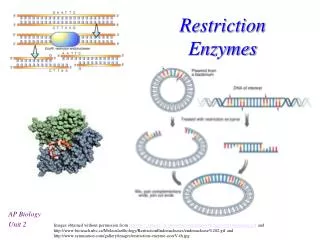
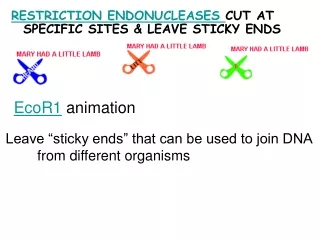
Restriction endonucleases cut DNA at specific sites X174 DNA HinfI HaeIII
Madam, I’m Adam. Gary knits a stinky rag. Harass sensuousness, Sarah. Go hang a salami, I’m a lasagna hog. Palindromes
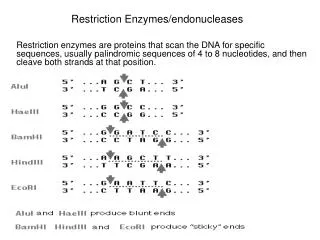
Most Restriction Enzymes Recognize Palindromes 5'-GATATC-3' 3'-CTATAG-5'
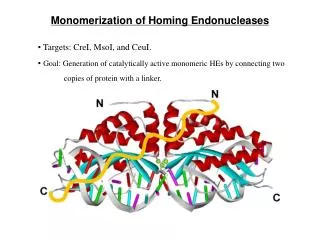
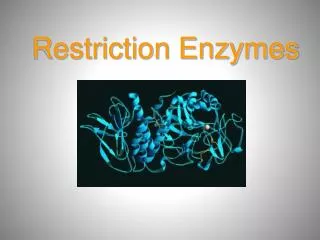
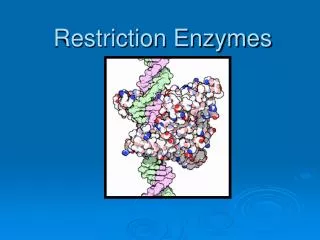
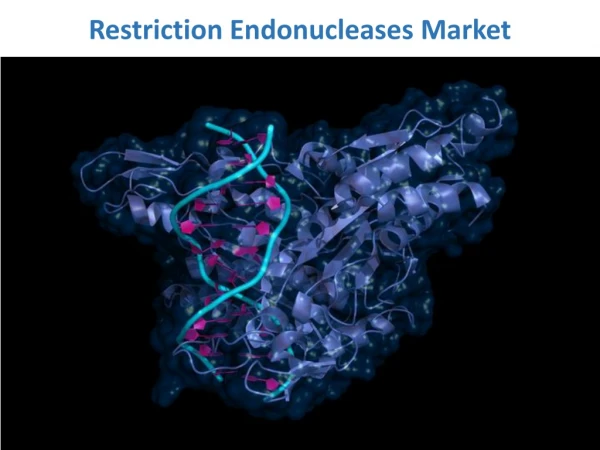
EcoRV Bound to DNA www.pdb.org 1AZ0
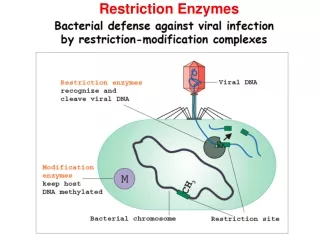
Phage l 48,512 bp dsDNA virus that grows on E. coli. Life cycle ~ 30 min at 37°C typical burst ~ 100-300 particles
Bacteriophage infection: 1 → 300 → 10,000 → 3,000,000 → 109! 30’ 30’ 30’ 30’ Phage DNA Bacterium 30 min Typical phage infection cycle: 1. Phage DNA penetrates bacterial envelope 2. Bacterial DNA is disrupted & phage DNA is replicated 3. Phage structural proteins are synthesized 4. Heads, tails, fibers made and assembled into particles 5. Cell lysis, release of ~ 100 – 300 phage particles
Werner Arber Dan Nathans and Hamilton Smith Nobel Prize in Physiology or Medicine 1978