Major Mountain Ranges and Geographic Features of the U.S. and Canada
250 likes | 375 Vues
The United States and Canada boast several prominent mountain ranges, including the Rocky Mountains, Appalachian Mountains, and Pacific Coastal Ranges. Other notable landforms include the Canadian Shield, Great Plains, and Grand Canyon. The region is also home to the Hawaiian Islands, known for volcanic activity, and the Aleutian Islands, a volcanic chain extending from Alaska to Russia. Major rivers include the Mississippi, St. Lawrence, and Colorado. The climates range from humid subtropical to tundra, influenced by the geographical diversity of these nations.


Major Mountain Ranges and Geographic Features of the U.S. and Canada
E N D
Presentation Transcript
The United States and Canada Physical Geography
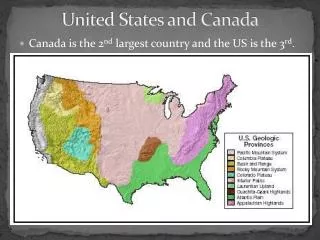
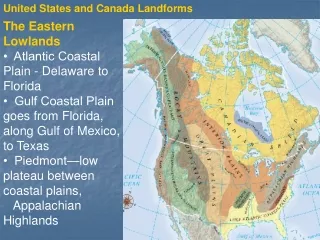
Mountain Ranges • The U.S. and Canada have several major mountain ranges: • Rocky Mountains • Appalachian Mts. • Pacific Coastal Ranges
Other Landforms • Canadian Shield • Great Plains • Gulf–Atlantic Coastal Plain • Grand Canyon
Groups of Islands • Hawaiian archipelago: • A group of 19 islands in the Pacific Ocean • formed over a hotspot in the earth’s crust • The largest island, Hawaii, has an active volcano. • Aleutian Islands: • A chain of over 300 small volcanic islands • extend from Alaska to Russia
Rivers • Some major rivers in the United States are: • Mississippi River • St. Lawrence River • Colorado River • Columbia River
Other Water Features • Some other important water features are: • Gulf of Mexico • Great Lakes • Arctic Ocean • Pacific Ocean • Atlantic Ocean • Hudson Bay
Climate • Canada and the United States are in the middle and high latitudes. The most common climates are: • Humid Subtropical • North / Central United States • Humid Continental • E / SE U.S. • Semiarid and Arid • Great Plain (semi-arid) and Southwest U.S. (arid) • Marine West Coast and Mediterranean • West coast of U.S. • Tundra • Northern Canada and Alaska • Tropical Wet • Hawaii