

SlideServe
Menu
Préférences
© SlideServe · v2026

TENNIS

rossa avatar
11 diapositives · 1.1K Views · Jul 23, 2014

TENNIS . Individual Sports Unit 2- Semester 1. Scoring. 0 pts = Love 1 pt = 15 2 pts = 30 3 pts = 40 4 pts = Game. If the score is 40-40, then it's called “ deuce ” Two options 1 . Next point wins!
TENNIS - slide 1
01 / 11TENNIS
1 / 17

Télécharger la présentation

TENNIS
Une image / un lien ci-dessous est fourni (tel quel) pour télécharger la présentation

Politique de téléchargement : le contenu du site vous est fourni TEL QUEL pour votre information et votre usage personnel ; il ne peut être vendu, concédé sous licence ni partagé sur d’autres sites sans l’accord de son auteur.Le contenu vous est fourni TEL QUEL, pour votre information et votre usage personnel uniquement. Téléchargez la présentation en cliquant sur ce lien. Lors du téléchargement, si vous ne parvenez pas à télécharger une présentation, l’éditeur a peut-être supprimé le fichier de son serveur.Pendant le téléchargement, si vous ne parvenez pas à obtenir une présentation, le fichier a peut-être été supprimé par l’éditeur.

F I N

Plus de contenu associé

Transcription de la présentation
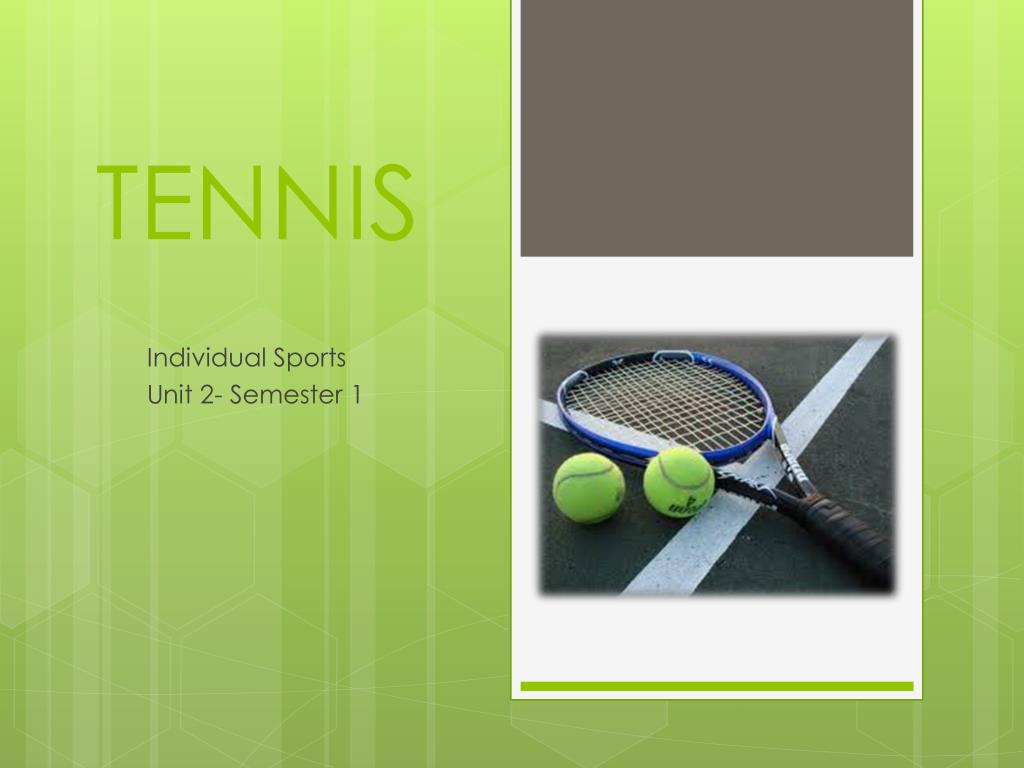
  1. TENNIS Individual Sports Unit 2- Semester 1

  2. Scoring • 0 pts = Love • 1 pt = 15 • 2 pts = 30 • 3 pts = 40 • 4 pts = Game • If the score is 40-40, then it's called “deuce” • Two options • 1. Next point wins! • 2. Play “ad” scoring, must win 2 points to win game. The server wins the point, “ad in,” server loses the point “ad out.”

  3. Scoring Continued… • Whoever calls out the score, their points are listed first. • Ex. The serving player has 3 points, the opponent has two points, the score would be 40 – 30. To the opponent who is not serving, the score would be 30 to 40.

  4. Match Information • Points, games, set, match • 4 points= 1 game • 6 games= 1 set • 2-3 sets= 1 match • Must win best 2 out of 3 games to win a match

  5. Ways of losing a point • Miss the ball completely on a swing. • Ball bounces twice before you hit it. • Hit the ball into the net. • You run into or touch the net. • You double fault on the serve. • You hit the ball more than once with your racket. • You hit the ball out of bounds.

  6. Scoring Vocabulary • All - indicates the scores are level. Example: “15 all” means that both players have a score of 15 • Deuce – when the score is 40-40 • Love - a score of zero points in a game or zero games in a set

  7. Vocabulary • Ace – When the opponent cannot touch the serve with their racket. • Double Fault – when you fail to get the second serve into the proper service court, loss of point • Fault - a serve which hits the net and / or lands outside the service box. • Foot fault - this happens when a server's foot touches the ground in front of the baseline or the wrong side of the center mark (on the baseline) before the player hits the ball • Service box - the area where players serve into • Let - when a serve hits the top of the net and lands within the service box, the server must serve again. • Rally - the exchange of shots between players. A rally starts when the receiver returns serve and ends when the point is won

  8. Types of Shots • Drop shot - a gently played shot that just gets over the net so the other player can't reach it • Ground stroke - a shot that is made after the ball has bounced

  9. Types of Shots cont…. • Lob - a shot played deliberately high into the air to land at the back of the opponent's court • Smash - an overhead shot hit very hard • Volley – a shot when the player is at the net, the ball usually will not bounce on this shot

  10. Game Play • The first serve is always done from the right side of the court. • After every point, the players switch to the other side of the center line for the service. • The ball must bounce on the return of service. • You have 2 chances to serve the ball into the proper service court, which is diagonal. • The players switch sides of the court when the total game score is an odd number, • examples: 1-0, 2-1, 3-0, 3-2, 4-1, 5-0, 5-2, 5-4, or game score is vice-versa.

  11. COURT DIAGRAM