Download
1 / 17
170 likes | 288 Vues
This overview explores how plants adapt to various environmental factors such as light intensity, temperature variations, and water availability. It details the differences between sun and shade plants, highlighting adaptations like leaf size and chlorophyll content. Additionally, it discusses morphological changes in response to temperature to minimize water loss, emphasizing features like serrated leaves and waxy cuticles. Adaptations to water stress, nutrient limitations, and gas exchange also play vital roles in plant survival, with examples including xerophytes, mesophytes, halophytes, and hydrophytes.

E N D
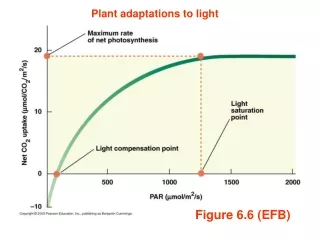
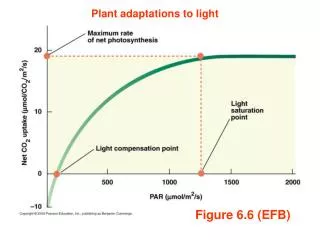
Plant adaptations to light Figure 6.6 (EFB)
Sun Plants more Rubisco less chlorophyll small leaves Shade plants less Rubisco more chlorophyll large leaves creosote arum
Light Attenuation A reduction in light intensity due to absorption, reflection, etc. Figure 3.3 (EFB)
Temperature affects leave shape and size Figure 6.11
In response to high temperatures, and • to limit water loss, plant morphology • can vary in having: • serrated or lobed leaves • small hair-like structures • waxy cuticles • small leaves • no leaves
Plants may also be able to acclimitize to seasonal shifts in temperature -- reversible physiological changes to cope with changes in local environment -- acclimate = change induced in laboratory -- acclimitize = change under natural conditions
Abcisic acid (ABA) produced to increase cell membrane permeability Response to photoperiod Response to first frosts
Adaptations to water stress Tap root in phreatophyte Spreading root system at surface
Nutrient limitations and carnivorous plants Pitcher Plants 4 spp. in our area
Adaptations to limitations in gases: CO2 and O2 Hydrophyte with lacunae
Plant categories based on adaptations: Xerophytes: desert plants Mesophytes: temperate plants Halophytes: salty soils Hydrophytes: aquatic environments