Cherenkov Emission Dynamics in High-Energy Air Showers: An EVA Simulation Study
This study presents the results of EVA simulations by Krijn de Vries, Olaf Scholten, and Klaus Werner, focusing on the emission mechanisms of high-energy air showers. We explore how the timing and geometry of radio pulses are influenced by Cherenkov effects, particularly at frequencies exceeding 1 GHz. Our findings reveal simultaneous arrivals of distant and near emissions, with implications for shower profiling and cosmic ray composition analysis. By investigating the relationship between pulse shapes and shower characteristics, we contribute valuable insights into high-energy particle interactions in the atmosphere.

Cherenkov Emission Dynamics in High-Energy Air Showers: An EVA Simulation Study
E N D
Presentation Transcript
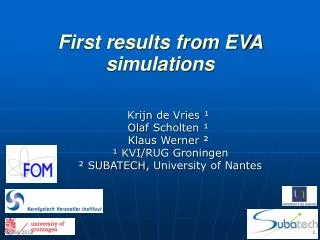
First results from EVA simulations Krijn de Vries¹ Olaf Scholten¹ Klaus Werner ² ¹ KVI/RUG Groningen ² SUBATECH, University of Nantes
Timing Radio pulse n=real n=1 !! Most distant emission arrives first c/n z = ct’ z = ct’ Distant & near emission may arrive simultaneously c c Arrives later c/n t = d2/2cz Large, sharp pulse
EVA - Emission MechanismsFrom Currents to radiation. D can vanish for realistic cases, n = n(z) ≠ 1 Cherenkov !
The extreme case for a realistic shower front 50 Shower profile 20
The extreme case for a realistic shower front A-typical example n=realistic E/10!! 50 Shower profile Arrival times reflected in pulse shapes 20 De Vries et al., PhysRevLett. 107, 061101 (2011), Alvarez-Muñiz et al., arXiv:1107.1189
EVA: Realistic shower frontHigh Frequencies!! Sharp pulse High frequency >1GHz E(mV/m) E(μV/m/MHz) /10 d=1170 m n=1 n=n(z) n=1.0003 t(ns) shower max@30 km (along sh axis) impact = 400 m, E=5x10¹⁷eV ν(MHz)
Length Scales • Cherenkov: • Shower front; cm or GHz • Normal: • derivative of the projected shower profile; m or 10 MHz
270 shower 100 m 400 m Cherenkov v.s. ‘normal’ Timing ! 0.1 ns v.s. 10 ns Time spectrum Frequency spectrum 1 GHz v.s. 10 MHz EASIER ? 100 100 1000 10 100 100
Cherenkov effects; Probing the shower profile No Cherenkov b>300 m Cherenkov dominant b=250 m Cherenkov + ‘normal’ θ = 60o, E=1017eV b<200 m
Cherenkov effects; Pulse in time E(μV/m) ~ 60 ns -200 t(μs) No Cherenkov b>300 m E(μV/m) ~ 4 ns Cherenkov dominant -7000 t(μs) b=250 m E(μV/m) Cherenkov + ‘normal’ ~ 8 ns b<200 m -3000 t(μs)
Cherenkov effects; Pulse in frequency 3 No Cherenkov b>300 m E(μV/m/MHz) Cherenkov dominant b=250 m 0.1 10 100 1000 5000 Cherenkov + ‘normal’ ν(MHz) Two bump structure for Cherenkov emission from below the shower maximum!! b<200 m
Two bump structure seen at ANITA? Simulation for 60 degrees shower at the Auger site. Geometry of ANITA event not known, so not 1 to 1 comparable!
The LDF: Determining the Chemical composition Chernkov ring clearly visible, becomes sharper at high frequencies! Link position d_max to emission height by: determined by X_max
Polarization of the radio emission:Determining the Charge excess in the Air Shower Leading: Geomagnetic Sub Leading: Charge Excess Geomagnetic: Charge excess (Askaryan): K.D. de Vries, O. Scholten, K. Werner: Proceedings of the 31th ICRC (2009), Lodz, Poland.
Polarization of the radio emission:Determining the Charge excess in the Air Shower
Polarization of the radio emission:The charge-excess fraction in the radio signal @ N-S
Conclusions Cherenkov effects lead to emission at very high frequencies > 1GHz Cherenkov emission below the shower maximum gives rise to a two bump structure in the frequency spectrum The Cherenkov ring gives information about the shower maximum The fraction of charge-excess in the radio signal is affected by Cherenkov effects and not constant
Retarded distance D (2) Ne·10-11 t': emission time t: observer time -t’(μs) t(μs) 2
Retarded distance D (2) Ne·10-11 t': emission time t: observer time -t’(μs) t(μs) 2
Retarded distance D (2) Ne·10-11 t': emission time t: observer time -t’(μs) t(μs) 2
Retarded distance D (2) Ne·10-11 t': emission time t: observer time -t’(μs) t(μs) 2
General Pulse shape Far from the Cherenkov distance: Cherenkov distance: Sharp edge of shower front Shower profile pre shower max Particle max Shower max 3
Retarded distance D (1) Observer 1