The Path to War
This exploration delves into pivotal moments that shaped the lead-up to the American Civil War, starting with the Compromise of 1850, which tackled issues like California's statehood and the Fugitive Slave Act. It highlights the significance of Harriet Beecher Stowe's "Uncle Tom's Cabin," a bestseller that influenced public opinion against slavery. The Dred Scott decision marked a critical judicial moment, while the political landscape shifted with the emergence of the Republican Party. Tensions escalated through violence and political strife, setting the stage for secession and war.

The Path to War
E N D
Presentation Transcript
The Path to War Why, America?
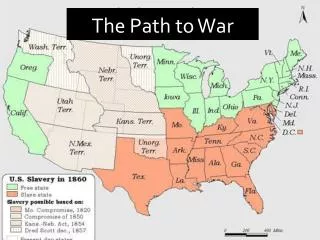
We Know the basic path…but let’s pull out some of the major issues/events: • Compromise of 1850: • California statehood • Fugitive Slave Act • Underground Railroad • Harriet Beecher Stowe’s Uncle Tom’s Cabin • Kansas – Nebraska Bill
Uncle Tom’s Cabin 1852 • Sold 300,000 copies inthe first year. • 2 million in a decade! • Best selling novel of the 19th century • Best selling book of the century next to the Bible
HarrietBeecherStowe(1811 – 1896) “So this is the lady who started the Civil War.” -- Abraham Lincoln
Dred Scott v. Sandford, 1857 • The Taney Court ruled 7-2 against Scott • Findings: • neither he, nor any person of African ancestry, could claim US citizenship • Therefore, Scott could not bring suit in federal court under citizenship rules. • b/c of the Fugitive Slave Act, the precedent of “once free always free” was no longer the case. • Later… The Emancipation Proclamation in 1863, and the post-Civil war 13th, 14th & 15th Amendments nullified the decision. “For if they [African Americans] were … entitled to the privileges and immunities of citizens, it would exempt them from the operation of the special laws … It would give to persons of the negro race, who were recognized as citizens in any one State of the Union, the right to enter every other State whenever they pleased… to have freedom of speech… And all of this would be done in the face of the subject race of the same color, both free and slaves, and inevitably producing discontent and insubordination among them, and endangering the peace and safety of the State.”
Let’s Talk Politics: What happened to the Whigs? • Sectional strife (north v. south) • Death of Zachary Taylor, Daniel Webster & Henry Clay Republicans (1854) • Formed from antislavery Whigs, Free Staters • Exclusion of slavery from new territories • Protective tarrifs • Federal funding for transcontinental Railroad • An Industrial North (work & opportunity were foremost) Democrats (Andrew Jackson’s old party) • For the extension of slavery into territories • Most southern democrats were NOT slaveowners • Appeal to racism to get white farmers on their side • Restrictions on slavery were anti-constitutional
Things got a LITTLE tense… May 22, 1856 Sen. Charles Sumner(R-MA) Rep. Preston Brooks(D-SC) “Crime Against Kansas!”
1860Presidential Election √Abraham LincolnRepublican John BellConstitutional Union John C. BreckinridgeSouthern Democrat Stephen A. DouglasNorthern Democrat
1860 Election Results
What does FREEDOM mean? North: Freedom to pursue self-interest without competition from slaves South: Freedom to dispose of their legally acquired property (slaves) how they wish
Next: War! …and irrevocable damage to the union…