Download
1 / 16
160 likes | 285 Vues
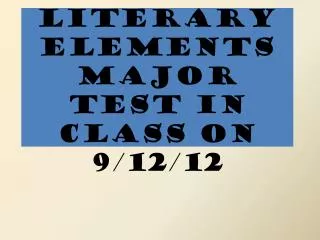
This study resource provides an overview of essential literary elements and nonfiction writing components, preparing students for the upcoming test on September 12, 2012. It includes a list of literary terms covered in class, reference pages from the Prentice Hall Literature Textbook (pages 4-7), a glossary of literary terms (pages R21-30), and workbook materials. Key topics include the basics of fiction and nonfiction, narrative prose, characterization, plot structure, setting, conflict, point of view, and themes. Gain insight into effective writing techniques and deepen your understanding of literary analysis.

E N D
Study Resources • Literary Terms List (given in class 1st week) • Prentice Hall Literature Textbook (students checked out copies 1st week) • pages 4-7 • Glossary of Literary Terms in back (pages R21-30) • Workbook pages students removed and should have in English binder
Fiction • narrative prose about characters and events from the author’s imagination • basic elements • setting • plot • Characters • Dialogue • point of view • theme
Setting • time and place a story takes place • Setting can also • establish social, cultural, or economic standards that affect characters • add complications to the plot • contribute to the mood of the story
Plotsequence of events in the story • Exposition • Rising action • Climax • Falling action • Resolution
Conflict • A struggle between opposing forces • This is the problem that sets off the sequence of actions I which rise to the Climax – the point of greatest intensity.
Internal and External Conflict • Internal Conflict is a struggle within the mind of one character • External Conflict is between two characters, between a person and a group, or between a character and nature or fate • Conflicts are stated as • Man vs. _______
CharacterizationWriters use different methods of revealing a character’s personality to the reader • Direct Characterization – writers make direct statements about a character’s appearance, personality, goals, habits, or beliefs • Indirect Characterization – Readers draw conclusions based on the character’s words, thoughts, actions, and interactions with others.
Point of View • 1st Person – told by narrator who is participating in the action • 3rd person – a voice outside the of the story narrates • Omniscient – “all knowing” - can tell readers what each character is thinking / feeling • Limited – sees the world through one character’s eyes and reveals only that character’s thoughts
Theme and Universal Theme underlying meaning or insight that an author conveys in a story Can be stated directly or implied A Universal Theme is a message about life that can be understood by most cultures. Examples: the important of honesty the danger of greed
Types of Fiction • Short stories - brief narratives, with carefully limited action that allows the writer to focus on one main plot complication • Novels - extended works of fiction that are usually organized into segments called chapters • can include subplots in addition to the main story line and may explore a number of characters in depth • Novellas - intermediate works of fiction that are longer than short stories but are concise and focused than novels.
Elements of Nonfiction • Tone - expresses an author’s attitude toward the subject and the reader. It is conveyed through choice of words and details • Perspective - the author’s point of view on the subject, including the opinions that the author expresses and the source of the author’s information—whether general research, for example , or personal experience • Purpose - author’s reason for writing. It may be to persuade, to inform, to entertain, or to describe
Nonfiction • Types of Nonfiction include • Literary Nonfictions • Informational Texts
Literary Nonfiction Literary Nonfiction – personal examples and ideas with factual information. Examples are Personal Essays and Biographies
Informational Texts • Expository - present facts to increase the knowledge and understanding of an audience Examples are summaries and articles • Persuasive - written to influence the opinions or actions of an audience. Examples are speeches, debates, and advertisements • Procedural - explains a process. These texts often include visuals to help illustrate steps. Examples are instructions, recipes, and manuals