
Real-Time Turbo Decoder
E N D
Presentation Transcript
Real-Time Turbo Decoder Nasir Ahmed Mani Vaya Elec 434 Rice University
Outline • Description of Turbo Encoding • Description of Turbo Decoding • DSP Implementation issues • Performance Analysis • Conclusions
Turbo Codes • First introduced in 1993 • Parallel Concatenation of two Convolutional Coders with interleaving • Original results showed a BER of 10E-5 at 0.7dB using block size 65,536 bits • For rate R=1/2 code, 0.7dB off channel capacity
Turbo Encoder • Parallel concatenation of at least two RSC encoders, with second encoder seeing interleaved version of data • Utilize only one of the systematic streams
Turbo Encoder • The output stream of data consists of the systematic data, parity bits from encoder1, and parity bits from encoder2 • Through the use of the interleaver, the decoder will have two independent looks at the same data, and can use both streams to decode the information sequence
Convolutional Coder • Utilize recursive systematic (RSC) encoders • Unlike feed forward coders, a single 1 in the input will lead to large weight codeword • Performance of turbo codes dependent on low weight codewords
Interleaver • Interleaving is used to reorder the input bits • Random interleaver used for large block sizes • For small block sizes (<1000), random/block interleavers show similar performance • Block interleavers have simple interleaving/de-interleaving mechanism
Importance of Interleaver • At a given SNR, tradeoff between latency due to interleaver and QOS • Small block sizes (~300 bits) can be used for real time voice • Mid range block sizes (~4000 bits) used for video play back • Large block sizes (~16000 bits) large latency, very low BER, useful for file transfer
Turbo Decoding • Two decoders used in serial fashion, with output of one decoder used as prior information to next decoder • Feedback in decoding circuit allows for multiple iterations, and improves bit error performance
Decoder • Constituent decoders need bit probability estimates to be used as priors to the next decoder: standard Viterbi cannot be used for this reason • Soft Output Viterbi Algorithm used (SOVA) • The output of decoder1 contains information that can be used as a prior probabilities for decoder2, and vice versa
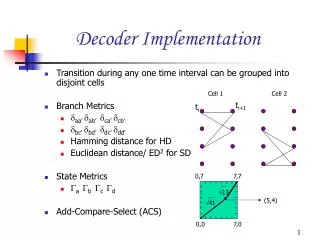
Steps in Viterbi Algorithm • Calculation of branch metric (distance from received data) • Calculation of path metric (Add compare select) • On reaching the end of trellis, start from the best state • Trace back (knowing the Path metrics) • Decide the data bits while tracing back
Steps in Turbo Decoding • Evaluate the path metrics • Trace back to obtain the decisions (x) • Trace back using alternate paths to obtain the metric differences • Compute the minimum of all possible metric differences for that stage • Obtain the reliability of decision • Pass this reliability of decision to next decoder • Iterate the above steps
Path Metric Calculation for SOVA s(i) : state of ith path at time k uk(i): information bit Ys: received systematic bit, Yp: received parity bit Mk(s(i)): path metric of ith path at time k Lc : Channel value = 4*Ec/N0 L(uk): output from previous decoder
Reliability of decisions Δlk= Mk+l(s(il)) – Mk+l (s(i’l)) Δlk : Metric difference l: index of all non surviving paths L(uk) = uk * Min(Δlk) Min(Δlk ) : Reliability of the decision
Our Implementation • Rate 1/3 coding • Constraint length = 3 • Frame length = 400 • SOVA algorithm used • Number of iterations are flexible
Algorithmic Issues • Two iterations of Turbo decoding used • Traceback depth set at 5 times the constraint length (optimal for Viterbi decoding) • BPSK modulation used (+/-1) • Extrinsic Information (Le(u)) scaled after every decoder
Fixed point Issues • Used Q-15 format • Received signal (from AWGN channel) clipped to lie in a range of +/-1 • Received signal scaled by a constant factor (32) to avoid overflow
Data Rates • Clock cycles / decoder = 654659 • Execution time / decoder = 4.36 ms • Data rate /decoder = 91.6 Kbps • Data rate/ iteration = 45.8 Kbps
Conclusions • Fixed point SOVA based Turbo decoder implemented • Performance of DSP matches MATLAB at high SNRs • Real time voice processing possible using our implementation (~22 Kbps for 2 iterations)