Disease
This overview explores the distinctions between communicable and non-communicable diseases, detailing how pathogens like viruses, bacteria, fungi, and protozoa cause infections. Communicable diseases, such as colds and influenza, spread between individuals or through the environment, while non-communicable diseases like heart disease and diabetes cannot be transmitted. We will define key terms, discuss various pathogens, their effects, and treatment options including antibiotics and antifungals. Learn how infections spread and how to protect yourself.

Disease
E N D
Presentation Transcript
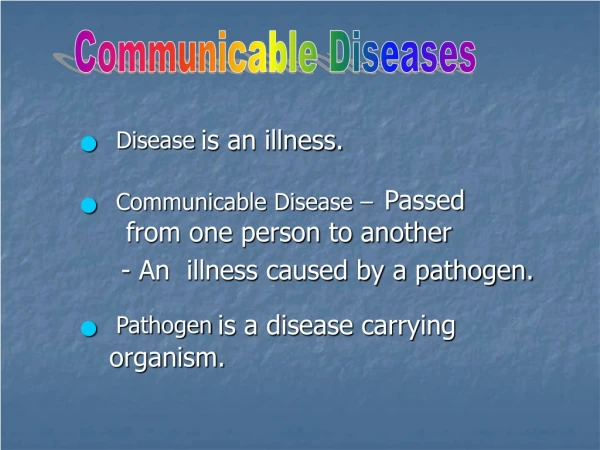
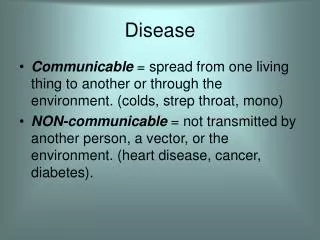
Disease • Communicable = spread from one living thing to another or through the environment. (colds, strep throat, mono) • NON-communicable = not transmitted by another person, a vector, or the environment. (heart disease, cancer, diabetes).
Definitions • Pathogens = organism that causes disease (virus, bacteria, fungi,etc.) • Infection = condition that occurs when pathogens enter the body, multiply, and damage body cells.
Virus • Pieces of genetic material surrounded by a protein coat. • Smallest known pathogens • invades host cell, takes over and copies • NO CURES • Run course and immune system will take over
Fungus • Plantlike organisms, molds and yeast. • Organic host • Athlete’s foot, yeast, ringworm • Cured with Anit-funglas
Bacteria • Single celled microorganisms that live almost everywhere on earth. • Harmful and beneficial • Can be cure with ANTIBIOTICS • Help digest food and make needed vitamins
Protozoa • Single celled organisms that are larger and more complex than bacteria. • Ex. Malaria and trichomoniasis • Cured with drugs that target protozoa • Rickettsias = resemble bacteria • Invade cells of another life form • Insect bites • Ex. Rocky Mountain Fever
Communicable Diseases • Cold = inflammation of mucous membranes. • Influenza = infection of respiratory tract. • Pneumonia = serious disease • Strep Throat = bacterial > direct contact. • Tuberculosis = attacks the lungs • Hepatitis = A, B, and C
Transmission • Direct Contact = touching, biting, kissing, and sexual contact. Sneezing or coughing can spread saliva or mucus to a person’s eyes, nose or mouth. • Indirect contact = Contaminated objects. Vectors (an infected carrier that transmits pathogen to humans or other animals). Water and food. • Airborne Transmission = pathogens that travel through the air for long periods of time (chicken pox, tuberculosis, and influenza).