Download
1 / 18
180 likes | 292 Vues
J.C. Maxwell developed four pivotal equations governing electricity and magnetism, crucial for understanding light. These equations highlight how light operates within the electromagnetic spectrum, where different frequencies correspond to various types of light. Frequencies range from AM radio waves to gamma rays, each with unique properties. Light classification can be based on frequency and wavelength, impacting technologies such as microwaves and UV lights. This guide serves to clarify the spectrum, its applications, and the significance of light in both our environment and technological advancements.

E N D
Maxwell’s Equations • J. C. Maxwell developed 4 equations which govern all of electricity and magnetism. • These 4 equations make light work. • You do not need to know these.
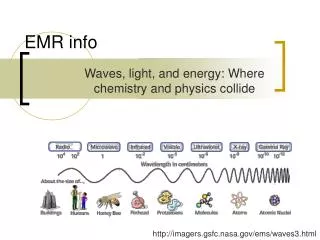
Spectrum • Just like sound is classified according to its pitch, there are different kinds of light, classified by their frequency. • The speed of light is constant.* • Therefore, a certain frequency of light will always have the same wavelength. • We can also classify light by wavelength.
Lowest Frequency EM waves AM (up to ~1 MHz) FM (90~100 MHz) Shortwave (in between) VHF (TV) UHF (TV) Cell Phone reception Radar Radio
The Gigahertz (GHz) range Wavelength in cm. Microwave ovens operate at 2.45 GHz This is a special frequency to cause resonance in water Microwave (-wave)
Wavelength in “micrometers” (m) Most commonly referred to as heat Hot objects radiate their thermal energy away. Up to a few hundred degrees, the radiant energy is in the IR range If we could see IR light, we would all shine brightly Infrared (IR)
The light we can see A tiny portion of the EM spectrum Red ( = 700 nm) Orange Yellow Green Blue Indigo Violet ( = 450 nm) Visible
Wavelength as low as 10 nm Used to kill germs Black Lights The part of sunlight that causes sunburn and skin cancer Partially blocked by the ozone layer Ultraviolet (UV)
These can be useful, but also dangerous Wavelength between 10 nm and 10 pm That is from 10 billionths of a meter to 10 trillionths of a meter X-Ray
< 10 pm High energy Dangerous Remember Gamma radiation from last semester Gamma Ray ( ray)
Practice • What is the wavelength of AM radio wave 960 kHz? • f = 960,000 Hz • c = 3 × 10⁸ m/s • = c/f • = 3 × 10⁸ m/s ÷ 960,000 Hz • = 312 m
Practice • What is the frequency of a “shortwave” radio wave 120 meters long? • = 120 m • c = 3 × 10⁸ m/s • f = c/ • f = 3 × 10⁸ m/s ÷ 120 m • f = 2,500,000 Hz = 2,500 kHz = 2.5 MHz
Practice • What is the wavelength of an FM radio wave? These waves are approximately 100 MHz (100 × 106 Hz). • f = 100,000,000 Hz • c = 3 × 10⁸ m/s • = c/f • = 3 × 10⁸ m/s ÷ 100,000,000 Hz • = 3 m
Practice • What is the wavelength of a microwave in a microwave oven? These waves are 2.45 GHz (2.45 × 10⁹ Hz). • f = 2,450,000,000 Hz • c = 3 × 10⁸ m/s • = c/f • = 3 × 10⁸ m/s ÷ 2,450,000,000 Hz • = 0.12 m = 12 cm
Electromagnetic Spectrum Radio Microwave Infrared Visible Roy G Biv Ultraviolet X Ray Gamma Ray Visible Spectrum Red Orange Yellow Green Blue Indigo Violet Conclusion -- Quiz Wed. (4/29)