Understanding Gibbs Free Energy: Predicting Reaction Spontaneity and Equilibrium
This comprehensive overview explores Gibbs free energy (ΔG), highlighting its significance in predicting the spontaneity of reactions at constant temperature and pressure. It details the relationship ΔG = ΔH - TΔS and how positive, zero, and negative ΔG values indicate non-spontaneous, equilibrium, and spontaneous reactions, respectively. The guide includes examples such as the reaction of calcium carbonate and thermodynamic calculations relevant to biological pathways like glycolysis. Lastly, it examines the implications of free energy on reaction kinetics, establishing a clear framework for understanding thermodynamic principles.

Understanding Gibbs Free Energy: Predicting Reaction Spontaneity and Equilibrium
E N D
Presentation Transcript
Thermodynamics Part 2
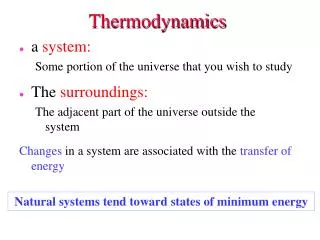
Free Energy • DG - Gibbs free energy - maximum possible useful work at constant T and P • DG = DH – TDS • Our predictive tool for reactions DG > 0 non-spontaneous DG = 0 at equilibrium DG < 0 spontaneous • For a spontaneous process: maximize entropy minimize energy
Standard molar free energy of formation - DGof DGof = 0 for free elements in standard state Calculate free energy change for a reaction CaCO3 (s) CaO (s) + CO2 (g) DGof : -1129 kJ/mole -604 kJ/mole -394 kJ/mole Is this a spontaneous reaction?
Is this reaction possible? CH4 (g) C (diamond) + 2H2 (g) Calculate DHorxn, DSorxn, and DGorxn DG = DH-TDS
Can the reaction become spontaneous? DG = 0 = DH - TDS Teq = DH/DS (estimate) Can it rain diamonds on Neptune and Uranus? Neptune/Uranus blue color – CH4 10-50GPa 2000-3000K
Hess’ Law C (graphite) + O2 (g) CO2 (g) DH1 C (graphite) + ½ O2 (g) CO (g) DH2 Can't run this reaction, you get CO and CO2 CO (g) + ½ O2 (g) CO2 (g) DH3 Reactions are additive!
C (graphite) + O2 (g) CO2 (g) DH1 CO (g) + ½ O2 (g) CO2 (g) DH3 C (graphite) + O2 (g) CO2 (g) DH1 CO2 (g) CO (g) + ½ O2 (g) -DH3 C (graphite) + ½ O2 (g) CO (g) DH2 = DH1-DH3
Biological pathways Important in the metabolism of glucose Glucose + 6O2 CO2 + H2O First step in glycolytic pathway: Glucose + HPO4-2 + H+ [glucose-6-phosphate]- + H2O DGo’ = 13.8 kJ Is this reaction spontaneous?
Coupled reactions Glucose + HPO4-2 + H+ [glucose-6-phosphate]- + H2O DGo’ = 13.8 kJ ATP-4 + H2O ADP-3 + HPO4-2 + H+ DGo’ = -30.5 kJ Glucose + ATP-4 [glucose-6-phosphate]- + ADP-3 DGo’ = 13.8 + -30.5 = -16.7 kJ
Free energy and the equilibrium constant DGo = -2.303RTlog K T - kelvin temperature R - gas constant – 8.314 J/K-mole • DGo > 0 K < 1 reactant favored • DGo = 0 K = 1 • DGo < 0 K > 1 product favored
log K = DGorxn x 1000 -2.303 x 8.314 J/K-mole x 298 K Diamonds are NOT forever! Cdiamond Cgraphite DGof : 3 kJ/mole 0 DGorxn = 0 – 3 = -3 kJ log K = 0.53 K = 100.53 = 3.4 very very very very slow kinetics