Exploring Our Solar System: A Comprehensive Overview**
Our Solar System is an intricate and fascinating collection of celestial bodies, including the Sun, eight planets, their moons, and countless minor asteroids, meteors, and comets. This informative piece delves into the characteristics and unique features of each planet—from Mercury's craters to Saturn's stunning rings—highlighting Earth's role as the only known abode of life. Additionally, we explore dwarf planets like Pluto and the mysteries of other solar system phenomena such as meteoroids and asteroids. Join us on this cosmic journey to understand our place in the universe!

Exploring Our Solar System: A Comprehensive Overview**
E N D
Presentation Transcript
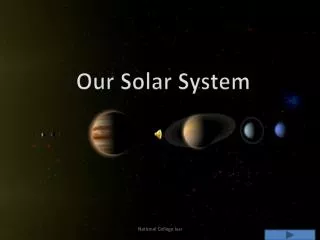
Our Solar System Our Solar System National College Iasi
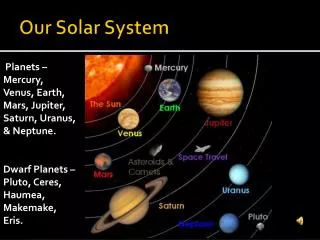
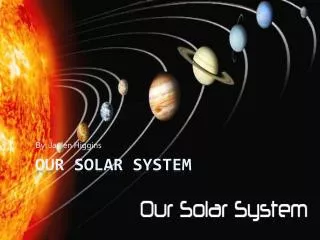
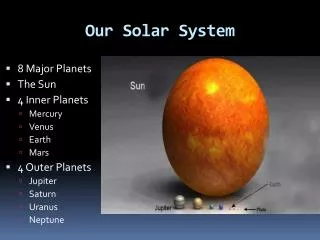
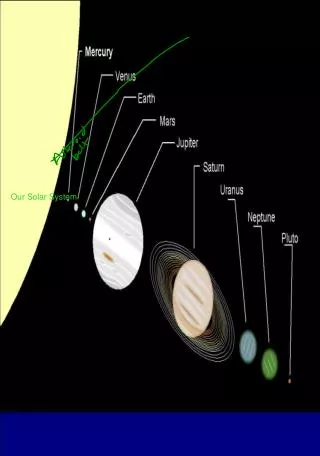
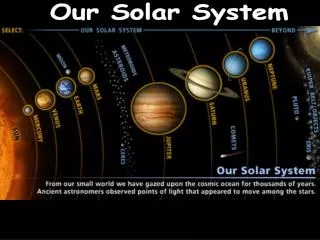
Our Planets • Sun • Mercury • Venus • Earth • Earth`s Moon • Mars • Jupiter • Saturn • Uranus • Neptune • Pluto • Others • Asteroids • Meteor and Meteorites • Comets National College Iasi
Sun • The Sun is the star at the center of the Solar System • The Sun's color is white, although from the surface of the Earth it may appear yellow because of atmospheric scattering of blue light • The sun is made up entirely of gase light • The sun, like Earth, is magnetic • The sun was born about 4.6 billion years ago • The inside of the sun and most of its atmosphere consist of plasma National College Iasi
Mercury • Mercury has very little atmosphere to stop impacts • it is covered with craters • Mercury’s surface is overall very similar in appearance to that of the Moon • The orbit of Mercury has the highest eccentricity of all the Solar System planets National College Iasi
Venus • is the brightest of the planets known to the ancients • it shows phases when viewed with a telescope from the perspective of Earth • Venus is only slightly smaller than Earth • There are no small craters on Venus • Venus is now quite dry • Venus has no magnetic field, perhaps because of its slow rotation. • Venus has no satellites National College Iasi
Earth • is the third planet from the Sunand the densest and fifth-largest of the eight planets in the Solar System • Home to millions of species including humans, Earth is currently the only place where life is known to exist • Earth's outer surface is divided into several rigid segments • Earth interacts with other objects in space, especially the Sun and the Moon • The planet is expected to continue supporting life for at least another 500 million years National College Iasi
Earth`s Moon • It is the second brightest object in the sky after the Sun • The Moon was first visited by the Soviet spacecraft Luna 2 in 1959 • there is no "dark side" of the Moon • The Moon has no atmosphere • Most rocks on the surface of the Moon seem to be between 4.6 and 3 billion years old • The Moon has no global magnetic field • With no atmosphere and no magnetic field, the Moon's surface is exposed directly to the solar wind National College Iasi
Mars • is smaller than Earth and Venus • It possesses an atmosphere of mostly carbon dioxide • Its surface, shows geological activity that may have persisted until as recently as 2 million years ago • Its red colour comes from iron oxide in its soil National College Iasi
Jupiter • is 2.5 times the mass of all the other planets put together • It is composed largely of hydrogen and helium • Jupiter has 63 known satellites • Ganymede, the largest satellite in the Solar System, is larger than Mercury National College Iasi
Saturn • Saturn distinguished by its extensive ring system • Saturn has 60% of Jupiter's volume • The rings of Saturn are made up of small ice and rock particles • Saturn has 62 confirmed satellites National College Iasi
Uranus • is the lightest of the outer planets • Uniquely among the planets, it orbits the Sun on its side • It has a much colder core than the other gas giants • radiates very little heat into space • Uranus has 27 known satellites National College Iasi
Neptune • Neptune, though slightly smaller than Uranus, is more massive and therefore more dense • It radiates more internal heat, but not as much as Jupiter or Saturn • Neptune has 13 known satellites • is accompanied in its orbit by a number of minor planets, termed Neptune Trojans National College Iasi
Pluto • is the second most massive known dwarf planet in the Solar System • is now considered the largest member of a distinct population known as the Kuiper belt • is composed primarily of rock and ice and is relatively small • Pluto and its largest moon, Charon, are sometimes treated as a binary system because the barycentre of their orbits does not lie within either body • has two known smaller moons, Nix and Hydra National College Iasi
Ptolemy's "planetary spheres”" National College Iasi
Asteroids • Asteroids are mostly small Solar System bodies composed mainly of refractory rocky and metallic minerals • The main asteroid belt occupies the orbit between Mars and Jupiter • Asteroids range in size from hundreds of kilometres across to microscopic • The asteroid belt contains tens of thousands, possibly millions, of objects over one kilometre in diameter National College Iasi
Meteor and Meteorites • A meteorite is a natural object originating in outer space that survives impact with the Earth's surface • Meteorites can be big or small • have been found on the Moon and Mars • are always named for the place where they were found, usually a nearby town or geographic feature National College Iasi
Comets • Comets are small Solar System bodies, typically only a few kilometres across, composed largely of volatile ices • They have highly eccentric orbits • Short-period comets have orbits lasting less than two hundred years • Long-period comets have orbits lasting thousands of years • Old comets that have had most of their volatiles driven out by solar warming are often categorised as asteroids National College Iasi
Attractions! Black Hole click here for details http://www.nasa.gov/multimedia/videogallery/index.html National College Iasi
The End! Scarlat Ioana Bianca Cojocariu Diana National College Iasi