Download
1 / 14
140 likes | 270 Vues
This document outlines the updates on the Class Size Amendment as of December 16, 2003, detailing district compliance with class size averages for grades K-3, 4-8, and 9-12. It discusses penalties for non-compliance, the appeal process for districts that demonstrate appropriate efforts, and the complications faced during implementation. Factors influencing teacher supply and demand, as well as projected student growth across various grade levels, are also reviewed, providing insight into the ongoing challenges in achieving class size reduction in Florida.

E N D
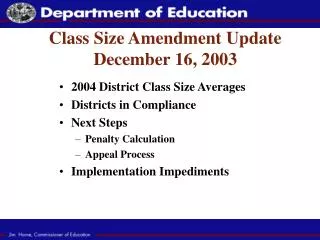
Class Size Amendment UpdateDecember 16, 2003 • 2004 District Class Size Averages • Districts in Compliance • Next Steps • Penalty Calculation • Appeal Process • Implementation Impediments
2003 Updated Baseline Grades K-3 23.06 Grades 4-8 24.16 Grades 9-12 24.10 2004 District AveragesChange Grades K-3 20.70 -2.36 Grades 4-8 22.59 -1.57 Grades 9-12 24.08 -0.02 District Class Size Averages 2
Districts Reducing to the Required Grade Group Cap or By 2 Students Districts % of Classroom Grade Group in Compliance Periods over Cap K-3 44 71.28 4-8 50 55.78 9-12 63 50.36 3
Penalty Calculation • Calculate an amount from the class size reduction operating categorical which is proportionate to the amount of class size reduction not accomplished. • Verify by Florida Education Finance Program Allocation Conference • Transfer funds to capital outlay 4
Example Penalty Calculation Formula: Proportion Under Target / Two Student Reduction = Proportion of Allocation Subject to Penalty X Grade Group Allocation = Dollar Amount Subject to Transfer to Capital Outlay Example: .25 / 2.00 = .125 X $1,000,000 = $125,000. 5
Appeal Process if District Did Not Meet “Requirements Despite Appropriate Effort To Do So” • District submits evidence • State Board of Education reviews evidence • Commissioner recommends alternative amount to be transferred • Legislative Budget Commission approves alternative amount to be transferred 6
Consequences of Continuing Non-Compliance • 2003-04 and 2004-2005 • Funds Transferred • 2005-06 • Funds Transferred • Tool Box Options Required • 2006-2007 • Funds Transferred • Tool Box Options Required • Constitutional Compliance Plan 7
Implementation Impediments • Space • Growth • Teacher Supply and Demand • Santa Rosa Experience 8
Student Growth Beyond Projections • Grades K-3 • 63 Districts with 1.5 % to 10% Growth • Grades 4-8 • 25 Districts with .4% to 5.3% Growth • Grades 9-12 • 31 Districts with .3 to 5% Growth 10
Factors Impacting Florida’s Teacher Supply/Demand Traditional: • Indicators of Shortages • Terminations • Normal Growth • Teacher Graduates New • Class Size Reduction • No Child Left Behind Requirement 11
Impact of No Child Left Behind Requirement on Florida’s Teacher Supply By July 1, 2006, all teachers teaching a core academic subject must be certified in that subject area to be considered highly qualified: English Civics and Government Reading or Language Arts Economics Mathematics Arts Science History Foreign Languages Geography 14