Understanding the Importance of Assessment in Education: Strategies and Considerations
80 likes | 208 Vues
In the course EDC423 led by Dr. Deeney, the vital role of assessment in education is explored. Assessment serves multiple purposes including measuring student comprehension, tracking improvement, and informing instructional methods. This course discusses various assessment strategies such as tests, portfolios, and projects, emphasizing both formative and summative assessments. Additionally, it delves into factors that impact comprehension and the assessment cycle, ensuring educators are equipped with the tools needed to support student learning effectively.


Understanding the Importance of Assessment in Education: Strategies and Considerations
E N D
Presentation Transcript
Assessment EDC423, Dr. Deeney
Why Do We Assess? • Have data to represent how our students are comprehending • To show improvement • Measure performance levels • To inform instruction • Grouping • Why SHOULD we assess?
How Do We Assess? • Tests (open-ended questions, multiple choice, essay, etc.) • Portfolios • Projects • Book reports • Diorama/drama • Retelling • Think-aloud
What Do We Assess? • Product • Process External/Visible Factors Internal/Invisible Factors
Factors that Affect Comprehension Sociocultural Task/Activity Text Teacher/Teaching Reader Context Adapted from Kucan & Palincsar IES 2009-2010
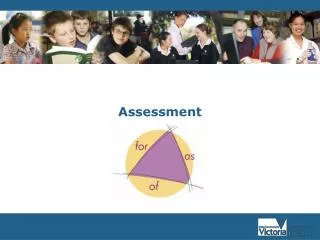
Assessment Terms • Formative Assessment • Summative Assessment • Formal Assessment • Informal Assessment • Assessment FOR learning (AFL) • Assessment OF learning (AOL)
What Might the Reader Find Hard About Comprehension? • Inferring • Visualizing/imaging • Background knowledge • Attention • Ability to determine relevant from irrelevant within the text • Literary/metaphorical language • Idiomatic language
Assessment Cycle: APIE • Assess • Plan • Implement • Evaluate