Ionic Bond
This section explores the concept of ionic bonds and the characteristics of ionic compounds. An ion is defined as an atom or group of atoms with an electric charge, either positive or negative. Ionic bonds arise from the attraction between these charged ions. Ionic compounds, made of metals and nonmetals, must have an overall zero charge. The properties of these compounds include hardness, brittleness, high melting points, and the ability to conduct electricity in solution. Learn about the correct naming conventions for ionic compounds, including examples like Sodium Chloride and Magnesium Oxide.

Ionic Bond
E N D
Presentation Transcript
Ionic Bond Chapter 5 Section 2
Ions • Ion- Is an atom or group of atoms that has an electric charge • When an atom loses an electron it becomes positively charged. • When an atom gains an electron it becomes negatively charged. • Polyatomic ions are ions that are made of more than one atom, and they have an overall positive or negative charge.
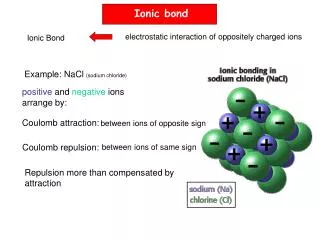
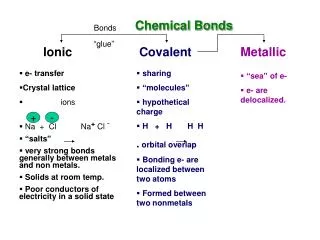
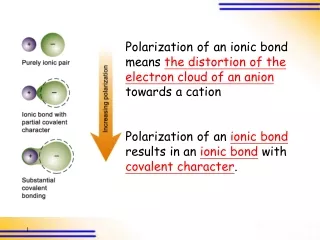
Ionic bonds are formed as a result of attraction between positive and negative ions. • Ionic compounds consists of positive and negative ions example: Sodium Chloride NaCl
Chemical Formulas and Names • Ionic compounds are made up of a metal and a nonmetal • To write the formula of an ionic compound you must make sure the compound’s overall charge is zero. (listen to explanation). • To name an ionic compound you should name the positive ion first followed by the name of the negative ion. Example: Magnesium Oxide. Notice the ending of negative ion it is always -ide
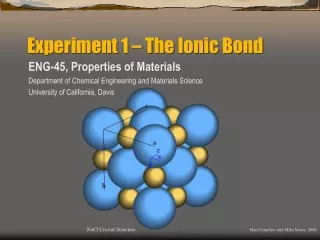
Properties of Ionic Compounds • 1. Hard, brittle solids • 2. Have high melting points • 3. They make a three dimensional pattern called crystal or crystal lattice. • 4. Solutions of ionic compounds conduct electric current.