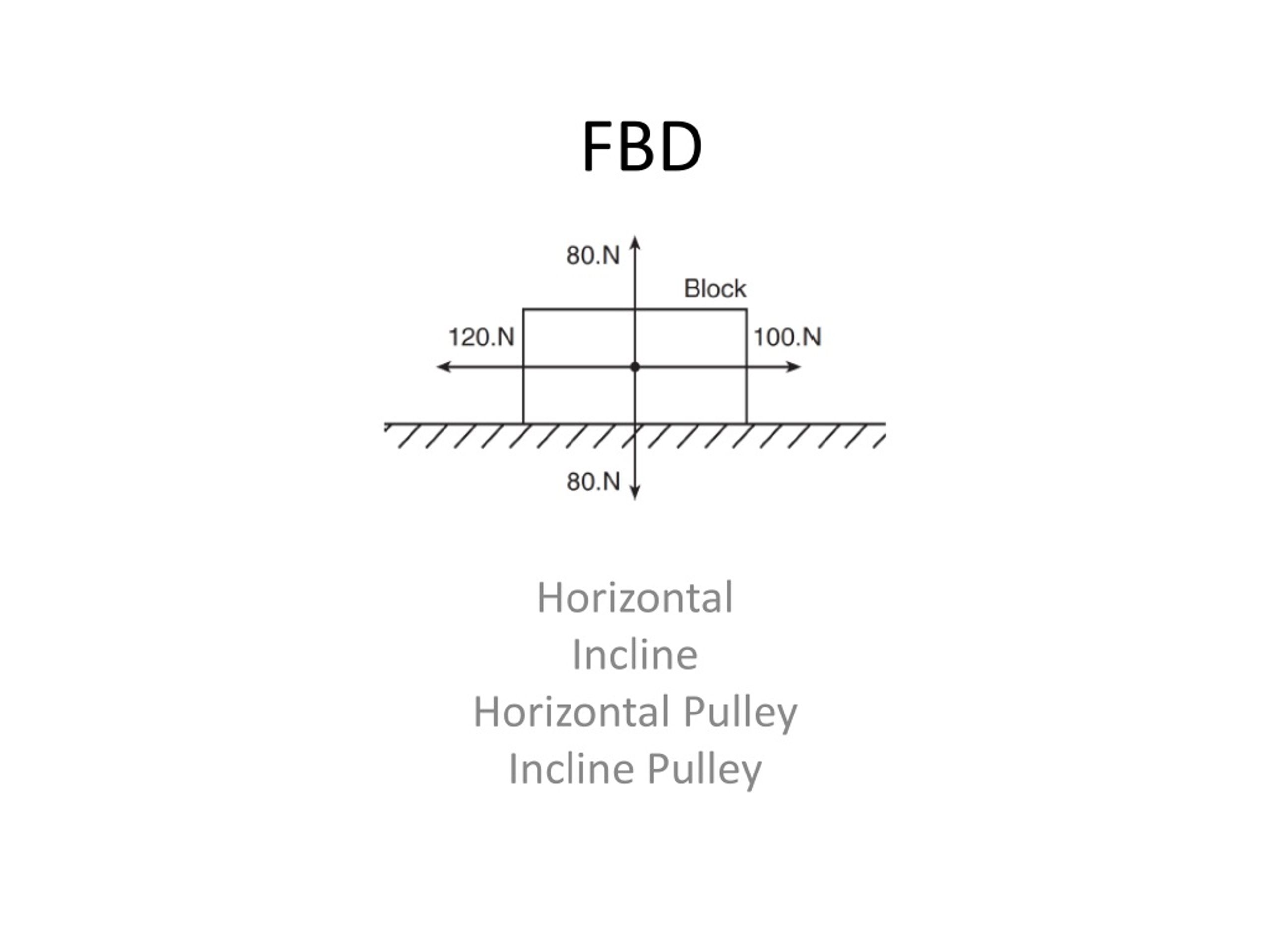
FBD. Horizontal Incline Horizontal Pulley Incline Pulley. Net force:. The net force is a combined total force acting on an object. Symbol - F net ΣF- “sum of all forces”
Une image / un lien ci-dessous est fourni (tel quel) pour télécharger la présentation
Politique de téléchargement : le contenu du site vous est fourni TEL QUEL pour votre information et votre usage personnel ; il ne peut être vendu, concédé sous licence ni partagé sur d’autres sites sans l’accord de son auteur.Le contenu vous est fourni TEL QUEL, pour votre information et votre usage personnel uniquement.Téléchargez la présentation en cliquant sur ce lien.Lors du téléchargement, si vous ne parvenez pas à télécharger une présentation, l’éditeur a peut-être supprimé le fichier de son serveur.Pendant le téléchargement, si vous ne parvenez pas à obtenir une présentation, le fichier a peut-être été supprimé par l’éditeur.
Net force: • The net force is a combined total force acting on an object. • Symbol - Fnet • ΣF- “sum of all forces” • We represent force by using vectors- arrow symbols that represent magnitude and direction by their length and which way they point on FBD.
How to analyze forces acting on an object making ΣF statements: • You need two statements: • The first tells what the object is doing: • Not moving = ΣF =0 (forces balanced/in equilibrium) • Accelerating = ΣF = ma (forces unbalanced/non-equilibrium) • Then the next statement explains why it’s not moving or is accelerating. List the forces responsible: • ΣF = Ff (friction opposing movement) – FA (an applied force- push or pull) • Then because these two statements are describing the same thing (one is “what” is happening, the other is “why”) the two statement can be set equal to each other and missing information can be solved for. • Lets take a look…
Let’s look at forces acting on this box: FN – The Normal Force- table pushing up on the box- THIS IS ALWAYS PERPENDICULAR TO THE SURFACE AND EQUAL TO THE Fg IF THERE IS NO ACCELERATION. Stationary: F1 = 20 N F2 = 20 N 10 kg FN Fg (“mg”)- weight What is the Fnet acting on this box horizontally: F2 F1 ΣF = 0 (box not moving/accelerating) Why not? ΣF = F2 – F1 0 = F2 – F1 w + F1 + F1 F1 = F2 FORCES ARE BALANCED
Let’s look at forces acting on this box: FN FN F1 = 20 N F2 = 40 N 10 kg F2 F1 Fg What is the Fnet acting on this box horizontally: w ΣF = ma (box accelerating) FORCES ARE UNBALANCED Why? ΣF = F2 – F1 What is the magnitude of acceleration on the box- solve for a ma = F2 – F1 m m a = F2 – F1 m
But what if the box had an initial motion: FN Moving with a constant velocity: FN F2 F1 = 20 N 10 kg F2 = 20 N F1 w Fg What is the Fnet acting on this box: ΣF = Fnet = F1 - F2 = 20 N - 20 N = 0 FORCES ARE BALANCED The Fnet is zero which means there is not a change in movement or direction. It is moving just not accelerating. This box will continue to move with a constant velocity.
Friction: • Friction is the force that opposes motion. • Without friction a car wouldn’t be able to start or stop (without hitting something). • Ff • Vector- shows magnitude and direction.
The force of friction is always parallel to the 2 surfaces that are in contact. • The amount of friction depends on the material in contact. The friction between those surfaces is going to be different than friction between metal and ice. Here the material in contact is rubber (tires) on concrete.
Two kinds of friction: Kinetic Friction (Ffk) Static Friction (Ffs) moving friction Not moving friction Friction between objects when they are in motion. Opposes the start of motion
vi vf a d t w N FA Ff µ m ΣFx ΣFy FBD-A 0 36 m/s 180 N 0 10 kg
vi vf a d t w N FA Ff µ m ΣFx ΣFy FBD-B 30 m/s 80 m/s 20 s 0 100 kg
vi vf a d t w N FA Ff µ m ΣFx ΣFy FBD-C 10 m/s 100 N 10 s Draw a FBD to a scale of 1 cm = 20 N 0 20 kg
vi vf a d t w N FA Ff µ m ΣFx ΣFy FBD-D 20 m/s 150 m 40 N 0 10 kg
vi vf a d t w N FA Ff µ m ΣFx ΣFy FBD-E 0 10 s 100 N 0.2 30 kg
vi vf a d t w N FA Ff µ m ΣFx ΣFy FBD-F 0 FA = 100 N 10 s 0.1 10 kg
vi vf a d t w N FA Ff µ m ΣFx ΣFy FBD-G 0 30 m/s 10 s 0.4 20 kg
vi vf a d t w N FA Ff µ m ΣFx ΣFy 30 m/s HORIZONTAL FBD QUIZ w = mg FN = 100 kg (10 m/s2) 60 m/s = 1000 N ΣFy = 0= equilibrium Ff FA ΣFy= FN - w 10 s 0 = FN - w FN = w w FN = 1000 N ΣFx = ma = non- equilibrium d = ? ΣFx= FA - Ff d = vit + 1/2at2 0.4 Ff = ? d = 30m/s(10s) + ½(3m/s2)(10s)2 FA – Ff= ma Ff =µFN 100 kg d = 300m + ½ 300m +Ff +Ff =.4(1000 N) d = 450 m = 400 N FA = Ff + ma FA = 400N + 100kg (3 m/s2) a= ? FA = 700 N a= vf-vi t a= 30 m/s = 3 m/s2 10 s
30° FBD-H 1. NOT MOVING = ΣF = 0 FBD: FT FN FN FT w w 2. What forces are acting on this block? 3. What is the Force due to gravity? Fg = w = mg w = 100 kg (10 m/s2) w = 1000 N
30° FT FN 60° 30° w 4. Draw a skewed/psuedo FBD with x-y axis y FN x FT 30° w 5. Transpose the angles
6. Resolve the x and y components of w y FN x FT wx wy 30° w SOHCAHTOA wy = ? wx = ? (A) cos Θ = A H 30° sin Θ = O H wy (H) w cos Θ = wy w sin Θ = wx w wx wy = w cos Θ wx = w sin Θ (O) wy = 1000 N cos 30° wx = 1000 N sin 30° wy = 866 N wx = 500 N
7. A simplified FBD helps you solve the rest. y FN x TO THE RIGHT IS POSITIVE FT TO THE LEFT IS NEGATIVE wx = 500N wy = 866N ΣFy=? FN = ? ΣFx=? FT = ? NOT MOVING = ΣFy = 0 NOT MOVING = ΣFx = 0 ΣFy= FN - wy (SIGNS ARE IMPORTANT) ΣFx= FT - wx 0 = FN - wy 0 = FT - wx FN = wy FT = wx FN = 866 N FT = 500 N
40° FBD-I DO FOR HOMEWORK wy = ? wx = ? FN FN wy = w cos Θ FT FT sin Θ = O H wy = 1000 N cos 40° wx wy = 766 N sin Θ = wx w wy w w wx = w sin Θ wx = 1000 N sin 40° wx = 643 N
FN FT wx wy ΣFy=? FN = ? ΣFx=? FT = ? ΣFy = 0 ΣFx = 0 ΣFy= FN - wy ΣFx= FT - wx 0 = FN - wy 0 = FT - wx FN = wy FT = wx FN = 766 N FT = 643 N
30° FBD-J 1. MOVING, NO FRICTION = ΣF = ma FN Fg 2. What forces are acting on this block? 3. What is the Force due to gravity? Fg = w = mg w = 100 kg (10 m/s2) w = 1000 N
30° FN 60° 30° w 4. Draw a FBD – skewed graph FN y FN x w 30° w 5. Transpose the angles
y 6. Resolve the x and y components of w: FN x wx wy 30° w SOHCAHTOA wy = ? wx = ? (A) cos Θ = A H 30° sin Θ = O H wy (H) w cos Θ = wy w sin Θ = wx w wx wy = w cos Θ wx = w sin Θ (O) wy = 1000 N cos 30° wx = 1000 N sin 30° wy = 866 N wx = 500 N
A simplified FBD helps you solve the rest: y FN x TO THE RIGHT IS POSITIVE B/c it would move to the left and left is negative TO THE LEFT IS NEGATIVE wx = 500N wy = 866N ΣFy=? FN = ? ΣFx=? a = ? NOT MOVING up or down = ΣFy = 0 MOVING = ΣFx = -ma ΣFy= FN - wy ΣFx= - wx 0 = FN - wy -ma = - wx FN = wy a= wx -m FN = 866 N a= 500 N = 5 m/s2 100 kg
8. Find vf =? 9. Find d =? vi = 0 d = vit + ½ at2 a = 5 m/s2 d = ½ at2 d = 5 m/s2 (10 s )2 2 t = 10 s vf = vi + at d = 250 m vf = at vf = 5 m/s2 (10 s) vf = 50 m/s
30° FBD-K Now there’s friction. Predict a =? wy = ? wx = ? FN wy = w cos Θ Ff sin Θ = O H wy = 1000 N cos 30° wy = 866 N sin Θ = wx w w wx = w sin Θ wx = 1000 N sin 30° wx = 500 N
Without and with friction: Find vf =? Find vf =? Find d =? Find d =? vi = 0 vi = 0 d = vit + ½ at2 d = vit + ½ at2 a = 5 m/s2 a = 4.13 m/s2 d = ½ at2 d = ½ at2 d = 5 m/s2 (10 s )2 2 d = 4.13 m/s2 (10 s )2 2 t = 10 s t = 10 s vf = vi + at vf = vi + at d = 250 m d = 206.5 m vf = at vf = at vf = 5 m/s2 (10 s) vf = 4.13 m/s2 (10 s) vf = 50 m/s vf = 41.3 m/s
Q = ? Looking for the threshold angle. What is the maximum angle that we can tilt the box before it starts to move? FBD-L FN Ff ΣFx = 0 w FN Ff SOHCAHTOA wx = ? wy = ? wx = w sin Θ wy = w cos Θ (A) Θ wy (H) w ΣFy = 0 w ΣFy= FN - wy wx 0 = FN - wy (O) FN = wy FN = w cos Θ
wx = w sin Θ ΣFx = 0 Ff = ? FN = w cos Θ ΣFx= Ff - wx Ff =µFN Ff= wx Ff =.4 FN FN Ff =.4 w cos Θ Ff= w sin Θ Ff .4 w cos Θ= w sin Θ wx w w wy .4 cos Θ= sin Θ cos Θ cos Θ .4 = sin Θ cos Θ .4 = O/H A/H
20° FBD-M1 FN Ff w FN Ff SOHCAHTOA wy = ? wx = ? wy = w cos Θ (A) sin Θ = O H wy wy = 1000 N cos 20° (H) w w wy = 940 N sin Θ = wx w wx wx = w sin Θ (O) wx = 1000 N sin 20° wx = 342 N