SlideServe
Menu
Préférences
© SlideServe · v2026

Translation - Concept and Examples in Life

ruthannd avatar
18 diapositives · 229 Views · Jan 06, 2020

Learn about translation in geometry and its application in real life. Understand how shapes maintain size and shape after movement. Explore examples of translational movements in daily situations.
Translation - Concept and Examples in Life - slide 1
01 / 18Translation - Concept and Examples in Life
1 / 17

Télécharger la présentation

Translation - Concept and Examples in Life
Une image / un lien ci-dessous est fourni (tel quel) pour télécharger la présentation

Politique de téléchargement : le contenu du site vous est fourni TEL QUEL pour votre information et votre usage personnel ; il ne peut être vendu, concédé sous licence ni partagé sur d’autres sites sans l’accord de son auteur.Le contenu vous est fourni TEL QUEL, pour votre information et votre usage personnel uniquement. Téléchargez la présentation en cliquant sur ce lien. Lors du téléchargement, si vous ne parvenez pas à télécharger une présentation, l’éditeur a peut-être supprimé le fichier de son serveur.Pendant le téléchargement, si vous ne parvenez pas à obtenir une présentation, le fichier a peut-être été supprimé par l’éditeur.

F I N

Plus de contenu associé

Transcription de la présentation
  1. Rotation Reflection ???

  2. I perched on the bow and travelled further No, I perched on the stern and went further

  3. aCM aCM

  4. A A P B B D D C C G G P E E F F Q Q aCM aCM

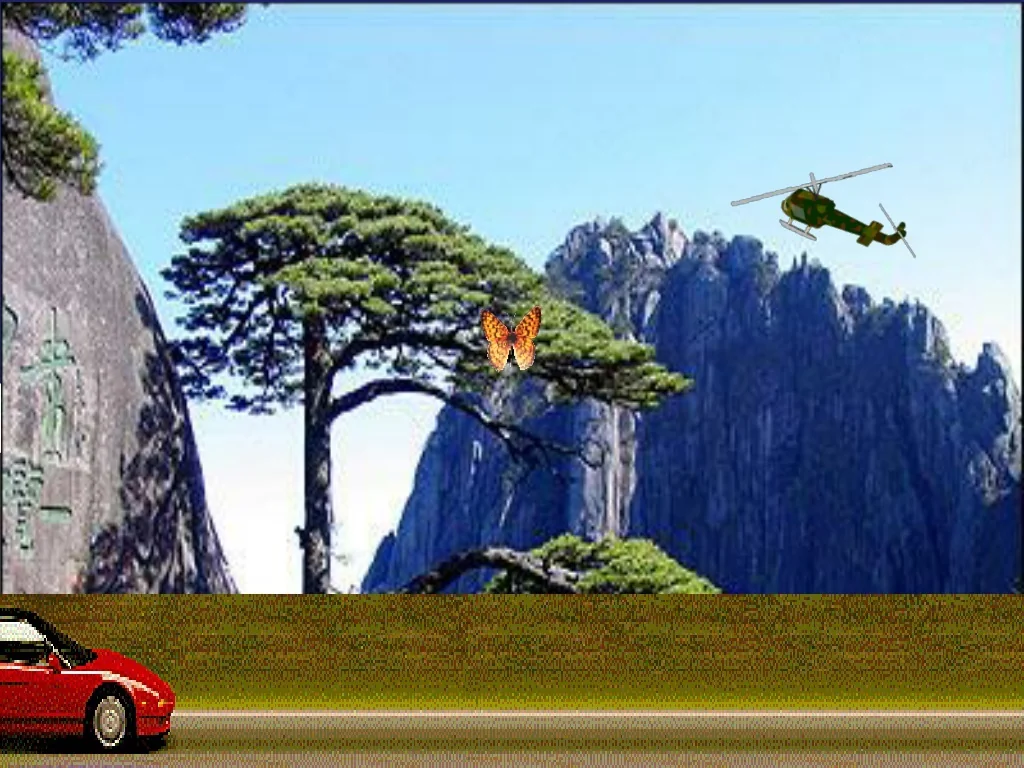
  5. On the graph all the points move in a certain direction and move the same distance. This is called Translation. After the shape is moved it maintains a constant and shape and size. Can you give some examples of translational movements in life?

  6. Title: Translation Copy and complete in your book: After an image is translated, the _________ between the ______________ points are equal. The ______ of the corresponding line segments are equaland the _______ corresponding angles are equal distance corresponding length size shape After the translation the______ and _______ are constant. size

  7. A A P ’ B B ’ D D C C G G P ’ ’ E E F F Q ’ ’ ’ ’ ’ Q ∠CAB and ∠C’A‘B’ are called corresponding angles Point A and point A' are called corresponding points. Line segment AB and line segment A'B' are called corresponding line segments

  8. On your whiteboards: Translation changes…(   ) A ShapeB Position C SizeD Shape, position and size B

  9. On your whiteboards: A D B C F E

  10. On your whiteboards: In the following 6 patterns which of patterns is a translation of image 1? • 1、如图,∠DEF是∠ABC经过平移得到的, ∠ABC=33°,求∠DEF的度数. (3)

  11. On your whiteboards: The four small triangles in the figure are all equilateral triangles with a side length of 2 cm. Which triangles are translations of △ABC? △ECD △FAE Translating△ABCgetsand ______

  12. On your whiteboards:

  13. On your whiteboards: Total area = area 1 + area 2 = area of EFCD = 1cm2

  14. Your Turn: Using Translation A square rice field with a side length of 101m has two channels in both sides, each with a width of 0.5m What is the area planted in each rice field? Show all of your calculations.

  15. Mark your work

  16. Can you explain this method? (101-0.5×2)2 =1002 =10000 m2

  17. Summary • Concept of translation • Nature of translation Moving all the points of a shape the same distance in a certain direction is referred to as translation. After the shape is translated, the distance between the corresponding points is equal, the length of the corresponding to the line segment are equal and the corresponding angle are equal in size. After the image is translated, the size of the image is unchanged and the shape of the image is unchanged.