
Comprehensive Analysis of Apyrase Genes Across Plant Species
This study focuses on the apyrase gene family, particularly APY1 and APY2, across various plant species including Arabidopsis thaliana, Glycine max, and Medicago truncatula. By examining their evolutionary relationships and expression patterns, we aim to understand the functional diversity of these genes in plant biology. The findings could shed light on their roles in nucleotide metabolism and stress responses, contributing to advanced plant genetics and breeding programs.

Comprehensive Analysis of Apyrase Genes Across Plant Species
E N D
Presentation Transcript
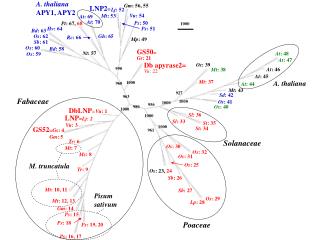
A. thaliana APY1, APY2 Gm: 56, 55 LNP2= Lj: 52 Vu: 54 Mt: 53 At: 69 At: 70 Ps: 50 Pt: 67, 68 1000 Ps: 51 Hv: 64 Bd: 63 Os: 62 Gh: 65 Rc: 66 Mp: 49 Sb: 61 Bd: 58 Os: 60 GS50=Gs: 21 Nt: 57 At: 48 Os: 59 At: 47 Os: 39 Db apyrase2= Vu: 22 990 At: 46 Mt: 38 At: 45 Mt: 37 A. thaliana 1000 960 At: 44 Mt: 43 927 Sd: 42 963 Fabaceae Os: 41 1000 1000 956 Os: 40 980 DbLNP= 1000 Vu: 1 Sl: 36 1000 LNP=Lj: 2 Sl: 33 St: 35 Vu: 3 1000 St: 34 GS52=Gs: 4 961 Gm: 5 Tr: 6 Solanaceae Os: 30 Mt: 7 Os: 32 Ms: 8 Os: 31 Os: 25 M. truncatula Tr: 9 Os: 23, 24 Sb: 26 Mt: 10, 11 Sb: 27 Pisum sativum Os: 29 Mt: 12, 13 Lp: 28 Gm: 14 Ps: 15 Ps: 18 Poaceae Ps: 19, 20 Ps: 16, 17