Independent and Dependent Probability for Composite Events
Learn about independent and dependent probability in composite events through examples, key concepts, and practice problems. Discover how to calculate probabilities for various scenarios involving multiple simple events.


Independent and Dependent Probability for Composite Events
E N D
Presentation Transcript
Independent and dependent Probability
Composite event – consists of two or more simple events Independent Event – The outcome of one event does not affect the outcome of the other event. Independent Probability
A coin is tossed and a spinner is spun. What is the probability that we will toss heads and spin a blue? Example 1
What is the probability of tossing a head? What is the probability of spun a blue? Example 1 (continue)
Draw a tree diagram to demonstrate the sample space Example 1 (continue)
What is the probability of tossing heads and spinning a blue? Example 1 (continue)
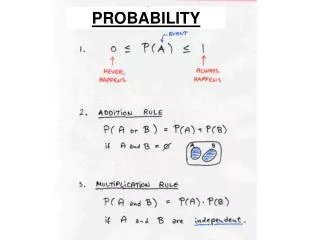
The probability of two independent events can be found by multiplying of the first event and the probability of the second event P(A and B) = P(A) * P(B) Key Concept of Independent Probability
A fair die is rolled and a spinner is spun. • What is the probability of having a 3 and spinning a red? • What is the probability of having a prime number and spinning a red? Practice 1
A jar contains 3 candies: Red, green and blue. Iris is going to draw a candy randomly and then she replace the candy back to the jar. After that she is going to draw a candy again. Determine the probability that she will draw a red candy on the first time and a blue on the second time. Practice 2
Independent Probability = With replacement Key Concept
Dependent Event – The outcome of one event DOES affect the outcome of the other event. Dependent Probability
Two marble are drawn successively without replacement from a box which contains 4 green marbles and 3 red marbles. Find the probability that Example
P (first draw is green) = P (second draw is red) (a) the first marble drawn is green and the second is red;
Dependent Probability = Without replacement • The probability of two DEPENDENT events can be found by multiplying of the first event and the probability of the second event Key Concept
A deck of card, what is the probability that you will draw a number four card on the first draw and then a black jack on the second draw? • Without putting it back • Putting it back Practice
Independent Practice – dependent and independent probabilityTake out a notebook paper and put down name, date and period on the paper
Jo has 2 pairs of black jeans, 3 pairs of blue jeans and 1 pair of tan jeans. He also has 4 white and 2 red shirts. If Jo choose a pair of jeans and shirt randomly, what is the probability that he will choose a pair of black jeans and a white T-shirt? • A jar contains 12 marbles. Four are red, three are white and 5 are blue. A marble is randomly selected, its color recorded, and then the marble is not going to return to the jar. A second marble is randomly selected. Determine the probability that the first draw is blue and the second draw is red. Independent Practice