Understanding Beach Renourishment: Benefits, Costs, and Environmental Impacts
210 likes | 365 Vues
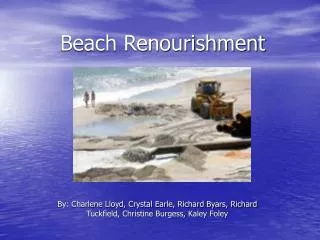
Beach renourishment involves replenishing sand to combat erosion and enhance beach aesthetics. Dredged sand is pumped through pipes onto beaches, where it is shaped into dunes. While it boosts tourism and benefits property owners, the practice poses ecological risks, including harm to marine life and sea turtle nesting habitats. Costs range from $10-15 million annually, and long-term efficiency is questioned. Funded by taxpayers and federal funds, the program raises concerns about sustainable beach management and impacts on surrounding environments.


Understanding Beach Renourishment: Benefits, Costs, and Environmental Impacts
E N D
Presentation Transcript
Beach Renourishment By: Charlene Lloyd, Crystal Earle, Richard Byars, Richard Tuckfield, Christine Burgess, Kaley Foley
What is Beach Renourishment? • Replenishment of sand for beaches • Sand is dredged off the ocean’s floor • Pump sand through pipes onto the beach • Sand is then shaped & built into dunes and beaches
Ecological Costs • Hurts sea life on ocean’s floor from dredging. • Sea turtle nesting areas are endangered by some renourishment projects. • Seawalls and jetties accelerate beach erosion.
How much does it cost? Is it a waste of money? • 10-15 million spent annually and more on hard structures • 200 cubic yards of sand has gone to renourish America’s beaches • Sand can cost as much as $5 per cubic yard • A new beach can cost 2 million per square miles • Beaches must be continually renourished
Does it work? • Yes, temporarily • Not efficient in long run • Extensive costs are not worth it
Who benefits? • Beach businesses • Tourists • Property owners • Historic preservationists
Who pays for beach renourishment? • U.S. Army Corps of Engineers designs and implements renourishment operations and pays for them.
Who pays… • Tax payers • 65% paid for by federal tax and the remainder of costs is paid by state and local governments. • Increased cost of taxpayer-subsidized flood insurance payments when floods and hurricanes occur.
How is this related to the Commons? • Public beaches are a commons. • Property owners and businesses are the “economic man.” • Individual gain in property values and tourism for businesses but all citizens pay • Temporary technical solution • Maximizes one beach while diminishing surrounding beaches
Pros Increased tourism/recreation Economic positives Aesthetically pleasing Cons Adversely effects the habitat of endangered species. Hurts Surf Zone Environments Program Hurts Taxpayers Pros and Cons
Resolution • Current beach renourishment programs do not work • Other possibilities…managed retreat and the UK • 5th Amendment implications
Work Cited • http://www.wrightsville.com/story_of_beach_renourishment_at_wrightsville_beach.htm • http://www.greenscissors.org/water/beach.htm • http://www.beachtobay.org/html/beach_renourishment.htm • http://wps.prenhall.com/esm_thurman_introocean_9/0,7305,348174-,00.html • http://comewalkwithme.com/Beach.html • http://www.islandtime.com/ShiftingSands/ • http://nhs.needham.k12.ma.us/cur/enviro_9697/beach/ beach.html