Introduction to Viruses and Their Structure
150 likes | 302 Vues
This resource provides a comprehensive overview of viruses, covering their properties, structure, and the enzymes involved in their replication. Students will learn about the various forms of capsid symmetry, the distinction between RNA and DNA genomes, and how viruses associate with diseases. The importance of viral control through hygiene and vaccines is also emphasized. By the end of the introduction, students should understand the basic elements of virology, including the necessity of living cells for viral infection and the characteristics of different virus structures.


Introduction to Viruses and Their Structure
E N D
Presentation Transcript
INTRODUCTION TO VIRUSES AND THEIR STRUCTURE: PETER H. RUSSELL, BVSc, PhD, FRCPath, MRCVS Department of Pathology and Infectious Diseases, The Royal Veterinary College, Royal College Street, London NW1 OTU. E-mailWeb site
ObjectivesStudents should be able to: • Summarise virus properties and control. • Describe virus structure and enzymes in outline
To associate a new virus with a disease it must be grown in pure culture and shown to be virulent.
The nucleic acid: Virus particles do not contain messenger RNA, this is in the host cell A virus will contain either an RNA or DNA genome
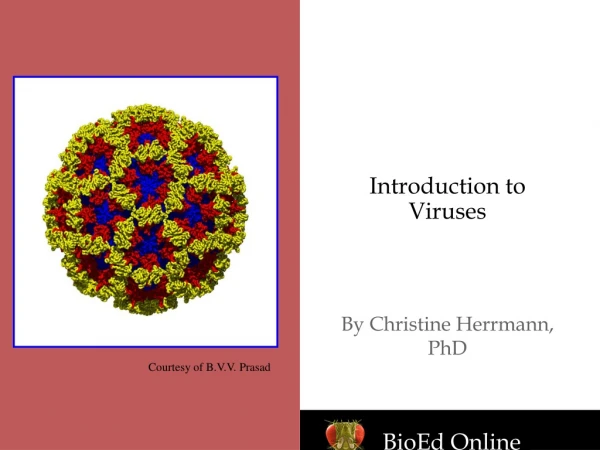
The capsid protein The capsid proteins protects the nucleic acid. They are arranged into are 3 forms of symmetry, icosahedral, helical and complex.
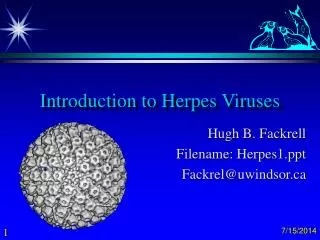
Icosahedral capsid An icosahedron has 12 vertices with 20 triangular sides, termed facets, like a geophysical dome. It is made of capsomeres, which appear spherical by em..
Enzymesand regulatory proteins These are virus proteins which are essential to virus replication. Some are present in the virus particle, others are only in the host cell.
Examples of non-structural enzymes found in the infected cell but not the virus :
Summary • Viruses require living cells and are therefore infectious but can be contained by hygiene/vaccines. • Several hundred particles which look identical are made in each infected cell overnight. • Viruses comprise a nucleic acid surrounded by protein. Some have an additional envelope which makes them more fragile.