Life in the Middle Ages: Feudalism, Castles, and the Influence of the Church
150 likes | 276 Vues
The Middle Ages, spanning from the fall of Rome to A.D. 1500, were marked by feudalism—a system where nobles supported kings in exchange for land and protection. Knights served as vassals to nobles, engaging in battles for their lords. Most people were serfs, farming land and paying taxes. Manors, consisting of castles, churches, villages, and farms, formed the backbone of this society. The church played a pivotal role in preserving education and the knowledge of ancient Greece and Rome during this challenging yet hopeful era.


Life in the Middle Ages: Feudalism, Castles, and the Influence of the Church
E N D
Presentation Transcript
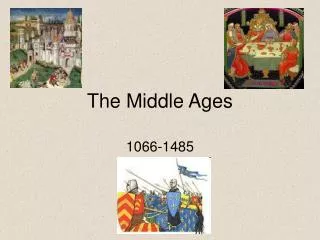
The years between the fall of Rome and A.D. 1500 are now called the Middle Ages.
Feudalism was a kind of government. It was also a way of life.
The nobles promised to help fight the king’s enemies. Knights were loyal to the nobles and the kings.
The kings gave land to the nobles under him. King Nobles Knights Serfs
The knights were called vassals of the king. They fought for their king or for other nobles. • Here we see the Knights of the Round Table belonging to King Arthur.
A serf was someone who farmed the land. Serfs had to pay rent and taxes to the nobles.
Most people in the early Middle Ages lived on a manor. A manor consisted of a castle, a church, a village, and farms.
The church saved education from completely disappearing after the fall of Rome.
Christian priests learned to read and write. All books were handwritten.
The church helped keep the knowledge of Greece and Rome from being forgotten.
The Middle Ages • The Middle Ages was a time of hardship, but also a time of hope.