Enhancing Water Quality Monitoring in the Chesapeake Bay - MARACOOS Initiative
30 likes | 156 Vues
The MARACOOS initiative, led by the Chesapeake Research Consortium, aims to elevate water quality monitoring in the Chesapeake Bay. With active continuous water quality monitoring since 1984, efforts include data collection through ship and satellite sampling. The program integrates partnerships with agencies like MD DNR and NOAA to drive improvements in water quality based on Total Maximum Daily Load (TMDL) models. Future initiatives focus on developing new hydrodynamic models for shallow waters, linking living resources and climate dynamics to ensure the health of the Bay by 2025.


Enhancing Water Quality Monitoring in the Chesapeake Bay - MARACOOS Initiative
E N D
Presentation Transcript
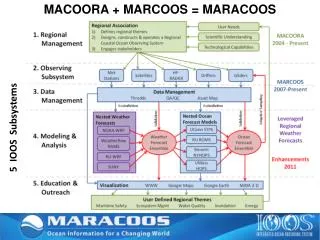
Enhancing Water Quality in MARACOOS Kevin Sellner Executive Director Chesapeake Research Consortium 15 December 2011 Sorry I could not attend!
CBOS & WQ • Most active and continuous WQ monitoring via MD DNR and VA DEQ WQ Monitoring Program • Since 1984, open and shallow water ship collections • Shallow water continuous data collection with moored/fixed sensor packages • Other WQ monitoring includes moored instrumentation from UMCES and NOAA Chesapeake Bay Office • Event Response ship & satellite sampling: NCBO, NOAA Oxford Lab, MD DNR, VA DEQ, ODU, UMCES, NASA, Hampton Roads Sanitation District, NOAA NOS
Why ‘Enhanced’? • Bay-wide TMDL models driven by these measurements • All jurisdictions in Bay watershed must meet implementation goals connected to load reduction targets by 2025 • Plans for 2012-2017 • New shallow water (<3 m) living resource ribbon hydrodynamic/WQ model for SAV/clarity, oysters, wetlands, erosion/resuspension to link with existing CH3D/ICM open water model • All driven/informed by continuous in situ measurements from sensor packages, not used previously • Expand all models to include climate change, climate-driven DO dynamics, waves, menhaden • Again, ALL informed/driven by the monitoring by CBOS partners so implementation of OOS packages insures future basin WQ predictions