
SlideServe
Menu
Préférences
© SlideServe · v2026

Prox-0.3

sai avatar
8 diapositives · 266 Views · Sep 19, 2014

Prox-0.3. Georgia Institute of Technology Kiichiro DeLuca Richard Zappulla Ian Chen Matt Uhlman. Mission Overview:. System Level Integration of Critical Subsystems
Prox-0.3 - slide 1
01 / 8Prox-0.3
1 / 17

Télécharger la présentation

Prox-0.3
Une image / un lien ci-dessous est fourni (tel quel) pour télécharger la présentation

Politique de téléchargement : le contenu du site vous est fourni TEL QUEL pour votre information et votre usage personnel ; il ne peut être vendu, concédé sous licence ni partagé sur d’autres sites sans l’accord de son auteur.Le contenu vous est fourni TEL QUEL, pour votre information et votre usage personnel uniquement. Téléchargez la présentation en cliquant sur ce lien. Lors du téléchargement, si vous ne parvenez pas à télécharger une présentation, l’éditeur a peut-être supprimé le fichier de son serveur.Pendant le téléchargement, si vous ne parvenez pas à obtenir une présentation, le fichier a peut-être été supprimé par l’éditeur.

F I N

Plus de contenu associé

Transcription de la présentation
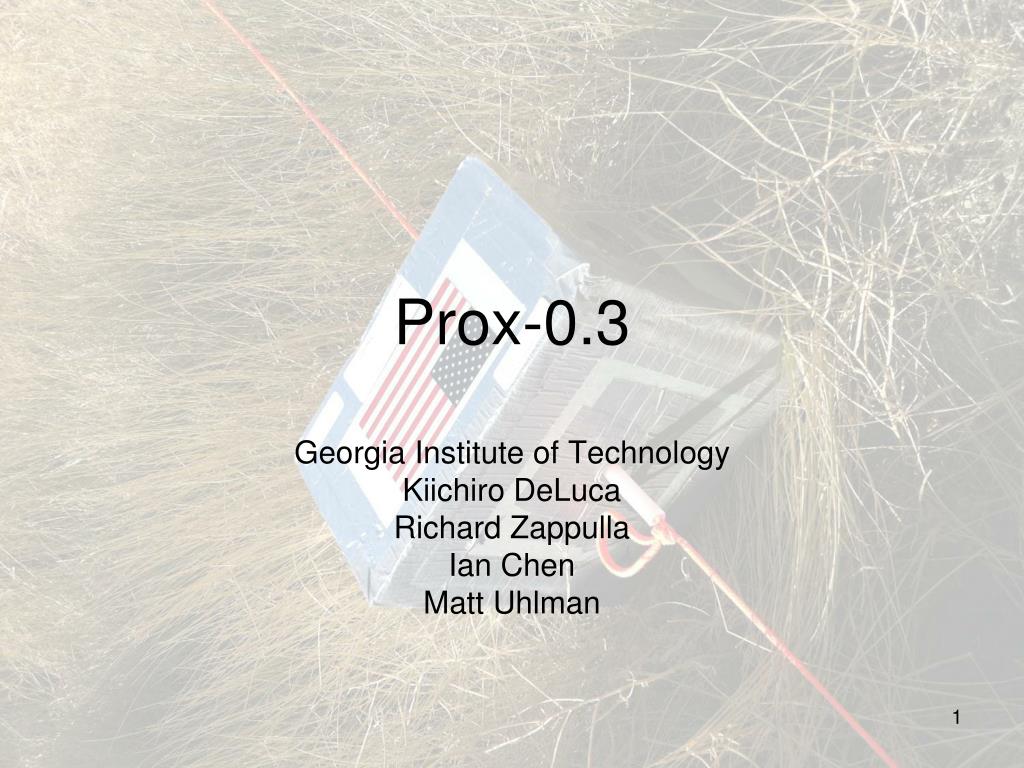
  1. Prox-0.3 Georgia Institute of Technology Kiichiro DeLuca Richard Zappulla Ian Chen Matt Uhlman

  2. Mission Overview: • System Level Integration of Critical Subsystems • Opportunity to integrate subsystems that are critical to satellite survival: Command and Data Handling, Electrical Power, and Thermal Control. • Flight Testing of Critical Subsystem Components • Power Management and Distribution Board • Power MOSFETs and Thermistors • Image Acquisition/Storage and On-board Processing • Visible image acquisition through web camera • Visible image storage on flash storage • OpenCV library for on-board image processing

  3. Expected Results: • Verification of nominal subsystem-subsystem interaction through log of command out and telemetry in to the Flight Compute Element • Thermistor Temperature • Heater ON/OFF • PMAD Board Voltage • Image acquisition at altitude • Verification of camera link to Flight Compute Element • PR Value! • Verification of on-board image processing routine on Flight Compute Element

  4. Actual Results: • Flight Recap: • Power initiated prior to flight string integration • Anxiously tracking and waiting for Prox-0.3 retrieval since data logged on-board • Results: • Structure/on-board electronics in tact • Data (images/telemetry log) not present on SD card • Average battery cell voltage at 8V compared to nominal 9V  thermal control successful?

  5. Preliminary Failure Analysis: • BeagleBoard experienced drops in voltage which resulted in second-stage boot-loader failure and system restarts. • Primary cause of failure: During image acquisition, board was accessing the USB bus and drawing too much current. • This problem was replicated after flight to confirm predicted reasons of failure. • Data collection failure due to compiling errors of UART communication scripts. • Primary cause of failure: Limited amount of development time with actual hardware.

  6. Lessons Learned: • System level hardware/software integration at early phase of development critical to mission success • Allow sufficient time to connect subsystems and test everything together. • Shift from traditional aerospace design philosophy to concurrent engineering needed • Risk associated with having all monitoring of critical telemetry reside on the central flight computer • Bring backup hardware!

  7. Conclusions and Actions: • While data was not retrieved during flight, ground tests showed all of the functionality in the mission overview • Moreover, many valuable lessons learned related to system integration and testing came out of the process up to and during the balloonsat flight • Success in the lessons learned

  8. Action Items and Impact to Prox-1: • Action Items to be fed back to NS-7 • Redesign and rapid build of the power management and distribution board • Investigate the possibility of monitoring critical telemetry on subsystem microcontrollers • Integrate components and subsystems early in the I&T phase • Shift our team’s approach to prototype development