The Evolutionary Roots of Cooperative Behavior: Kin Selection and Altruism
Cooperative behaviors are prevalent in the animal kingdom, particularly among genetically related individuals such as female banded mongooses who care for each other’s young. This article explores theories of altruism, including Hamilton's Rule, which considers direct and indirect fitness in kin selection. Examples highlight behaviors in species like black-tailed prairie dogs and white-fronted bee-eaters, showcasing the benefits of cooperation among relatives. Additionally, it examines social structures in eusocial organisms and phenomena like siblicide and reciprocal altruism in vampire bats, underlining the complexity of survival strategies in nature.

The Evolutionary Roots of Cooperative Behavior: Kin Selection and Altruism
E N D
Presentation Transcript
I. Motivation Cooperative behaviors are widespread. Why?
Genetically related female banded mongooses live and breed in groups, and care for each other's young
+, - Actor Recipient
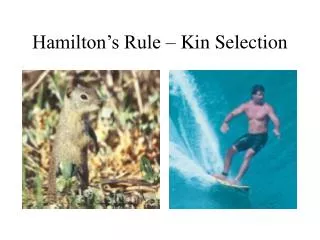
II. Theory of Altruism An individual’s survivorship and reproduction relative to other individuals in the population (Direct Fitness) Hamilton’s Rule (1964): Inclusive fitness = Direct fitness + indirect fitness Kin selection: natural selection favoring the indirect component of fitness (Benefit x relatedness) – Cost > 0; Br > C; r > C/B Benefit to recipient and cost to altruist Relatedness: probability that homolgous alleles in 2 individuals are identical by descent
Indirect Fitness through a Relative Computing relatedness with pedigrees The arrows describe paths by which genes can be identical by descent
III. Evidence Black-tailed prairie dogs give more alarm calls when kin are nearby
Male black-tailed prairie dogs change their alarm calling behavior when their living situation changes 5 males
Helping Behavior in Birds: White-fronted bee-eaters
In bee-eaters, helpers assist close relatives Fitness gains due to helping
More related birds are the more likely they are to cooperate Figure 12-17
Kin-selected discrimination in cannibalistic tadpoles and salamanders Benefit
IV. Special case of Sociality True or Eusociality = 1. overlap in generations between parents and offspring 2. cooperative brood care 3. specialized castes of nonreproductive individuals
Haplodiploidy produces unusual coefficients of relationship
father mother r = ½ ½ 1 1 sister sister Haplo-diploidy and Sister-Sister relationship Sisters on average share ½ genes through mother & all of their genes through father (1/2 + 1)/2 = ¾ Or ¼ + ½ = 3/4
phylogeny of the hymenoptera Origins of complex nesting behaviour
V. Siblicide and Parent-Offspring Conflict Masked boobies Blue-footed boobies Older sib sometimes pushes sib from nest Older sib always pushes sib from nest
VI. Reciprocal Altruism Vampire bats This photo shows a group of vampire bats roosting in a hollow tree Cooperative behavior among non kin
Conclusion • Cooperative behaviors are widespread • Inclusive fitness • (B x r) – C > 0 • Haplo-diploidy • Siblicide • Reciprocal altruism (Tit for Tat) • Other interesting topics: P-O conflict, sex ratio evolution, greenbeard alleles