THE CAPITAL ASSET PRICING MODEL (CAPM)
110 likes | 258 Vues
The Capital Asset Pricing Model (CAPM) evaluates the relationship between risk and expected return. It incorporates two types of risky assets, Stock A and Stock B, alongside a risk-free asset like a government bond or savings account. Key features of CAPM include the Capital Market Line (CML), which represents optimal investment portfolios, and the Market Portfolio (M), which is the best risky asset combination. The Security Market Line (SML) illustrates how expected returns correlate with risk, defined by the risk-free rate and the market risk premium.


THE CAPITAL ASSET PRICING MODEL (CAPM)
E N D
Presentation Transcript
THE CAPITAL ASSETPRICING MODEL (CAPM) • There are two risky assets, Stock A and Stock B. Now suppose there exists a risk-free asset—an asset which gives an annual interest payment with certainty. You can think of this asset as being a savings account in a bank or a government bond. The addition of a risk-free asset to the portfolio of risk assets leads to four new concepts:
THE CAPITAL ASSETPRICING MODEL (CAPM) 1. The capital market line (CML) is the set of all optimal investment portfolios for an investor. A portfolio on the CML is a combination of the risk-free asset and the risky assets.
THE CAPITAL ASSETPRICING MODEL (CAPM) 2. The market portfolio (denoted by the letter M) is the best portfolio of risky assets available to the investor.
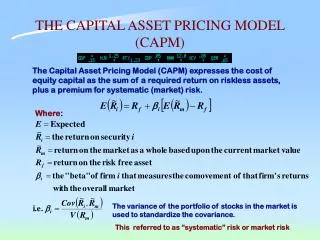
THE CAPITAL ASSETPRICING MODEL (CAPM) 3. The security market line (SML) describes the relation between the expected returns of any asset and the asset’s risk.
THE CAPITAL ASSETPRICING MODEL (CAPM) The SML says that the expected return on any portfolio of assets is related to the riskfree rate and the market risk-premium through the following relation: