Acceleration: Exploring the Rate of Change in Velocity
Learn about acceleration, the rate of change in velocity, with formulas, symbol, units, and demonstrations. Discover how force impacts velocity changes and solve acceleration word problems.

Acceleration: Exploring the Rate of Change in Velocity
E N D
Presentation Transcript
Acceleration The last topic in Physics!
Reminder • If you see this on a POSITION-TIME graph: • It means that the object is moving with UNIFORM MOTION • If you see this on a POSITION-TIME graph: • It means that the object has a CHANGE in VELOCITY
Reminder • A CHANGE in VELOCITY means that the object has either: • Changed speed (faster or slower) • Changed direction • Both
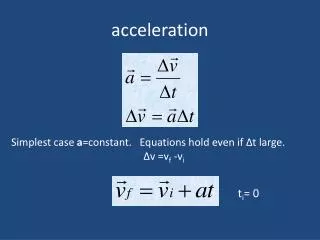
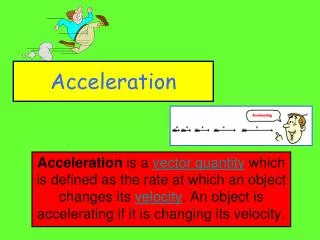
Acceleration • Acceleration is the rate of change in velocity • Acceleration refers to the change in velocity over a period of time Think about it… if velocity is the change in displacement over a period of time, what do you think the formula for acceleration is?
Acceleration • Q: What is the symbol for acceleration? • A: a • Q: What is the formula for acceleration? • A: • Q: What are the units of measurement for acceleration? • A: m/s2
Acceleration and Newton • Sir Isaac Newton (1643-1727) came up with several key formulas that help us understand the world around us. His second law applies to what we’re learning now: • In simple terms, this formula tells us that FORCE IS ACCELERATION… so acceleration is just a push or pull on an object that causes it to change the velocity it’s moving at Force = a push or a pull
Reminder First, establish which direction is positive and which direction is negative: West East Left -------------------------- Right South---------------------------- North Down Up
Acceleration = Force • Acceleration = force (a push or a pull)… so to figure out if the acceleration is + or – just think of what direction you would have to push someone to change their velocity
Pushing Demonstrations! • Stand up and push your chairs in. Make sure the aisles are clear • Grab a partner. Look them in the eye and say, “I trust you.” • Listen to Ms. T for directions
Example A Velocity Direction Δv = vf - vi Acceleration + 2 m/s to + 6 m/s • --------------------------------------------------------------- vivf + + 6 – 2 = + 4 m/s +
Example B Velocity Direction Δv = vf - vi Acceleration + 8 m/s to + 1.5 m/s • ------------------------------------------------------------- vivf + + 1.5 – 8 = - 6.5 m/s -
Example C Velocity Direction Δv = vf - vi Acceleration - 7 m/s to -3 m/s ------------------------------------------------------------- vf vi _ _ -7 – (-3) = - 4 m/s _
Example D Velocity Direction Δv = vf - vi Acceleration 0 m/s to -9 m/s ------------------------------------------------------------- vf vi _ _ 0 – (-9) = +9 m/s +
Acceleration Word Problems • A skater goes from a standstill to a speed of 6.7 m/s in 12 seconds. What is the acceleration of the skater? a = vf – vi tf – ti a = 6.7 12 12 a = 6.7 – 0 12 - 0 a = 0.6 m/s2
Acceleration Word Problems • During a race, a sprinter increases from 5.0 m/s to 7.5 m/s over a period of 1.25s. What is the sprinter’s average acceleration during this period? a = vf – vi tf – ti a = 2.5 1.25 a = 7.5 – 5 1.25 - 0 a = 2m/s2
Acceleration Word Problems • You are hiking down a mountain at -3.5 m/s when you start getting chased by zombies. You speed up to -9.7 m/s really quickly (like, in 5 seconds). What is your acceleration? a = vf – vi tf – ti a = -6.2 5 a = -9.7 – (- 3.5) 5 - 0 a = -1.24 m/s2
Acceleration Word Problems A baby sitter pushing a stroller starts from rest and accelerates at a rate of 0.457m/s2. What is the velocity of the stroller after it has traveled for 36 seconds? Δv = a x Δt Δv = 0.457 x 36 Δv = 16.452 m/s vf = Δv + vi vf = 16.452 + 0 vf = 16.452 m/s