Understanding Colligative Properties of Solutions: Effects of Particle Concentration
This article delves into colligative properties, which describe physical changes in solutions based on particle count rather than identity. Key concepts include vapor pressure lowering, boiling point elevation, and freezing point depression. The distinctions between electrolytes (like NaCl) and non-electrolytes are highlighted, with a focus on how these substances dissociate in solution. Practical examples and mathematical calculations for boiling point and freezing point changes are provided, revealing the significance of these properties in real-world applications, such as road de-icing.

Understanding Colligative Properties of Solutions: Effects of Particle Concentration
E N D
Presentation Transcript
Solutions Part 4
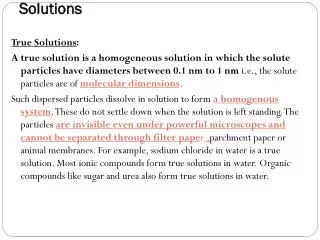
Colligative Properties • Physical properties of solutions that are affected by the number of particles, not the identity of the particles. • Include: • Vapor pressure lowering • Boiling point elevation • Freezing point depression
Electrolytes NaCl Na+ + Cl- • When sodium chloride is dissolved in water, the compound dissociates almost completely into ions • A 1m solution of NaCl produces 2m of ions • Solutions with electrolytes conduct electricity
Practice • How many ions do each of the following dissociate into? • MgCl2 • Ca(OH)2 • Fe3(PO4)2 • C6H12O6
Non-Electrolytes • Solutions with non-electrolytes do not conduct electricity • Non-electrolytes dissolve, but do not ionize • Colligative properties depend on the number of particles in solution
Vapor Pressure Lowering • Vapor pressure is the result of atoms at the surface evaporating and exerting pressure on the surface • Solutes interfere with this process, thus lowering the vapor pressure • The greater the number of particles of solute, the lower the vapor pressure
Boiling Point Elevation • Because the vapor pressure has been lowered, it takes more kinetic energy to boil the solution compared to the pure solvent • BPE is the difference in boiling point temperature ΔTb = Kbm Kb – boiling point elevation constant
Boiling Point Elevation • What is the boiling point elevation of a 0.029m NaCl solution? (Kb of water = 0.512 °C/m)
Freezing Point Depression • The solute particles interfere with the ability of the solvent to form a solid. • The freezing point of a solution is lower than the freezing point of a solvent. ΔTf = Kfm
Freezing Point Depression • What is the freezing point depression of a 0.029m MgCl2 solution? (Kf of water = 1.86 °C/m)
Freezing Point Depression • Which would be more effective to use to prevent roads from icing over, NaCl or MgCl2?