Understanding Blood: Functions, Composition, and Types of Blood Cells
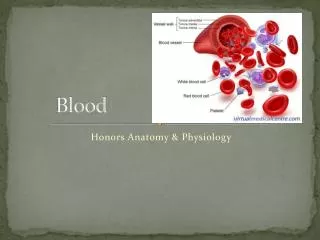
Blood serves essential functions in the human body, including the transportation of oxygen, carbon dioxide, nutrients, hormones, and waste products. It helps regulate body temperature and pH while offering protection through clotting and immune responses. Blood is primarily composed of plasma, water, plasma proteins, and various cells, including red blood cells (RBCs), white blood cells (WBCs), and platelets. RBCs carry oxygen thanks to hemoglobin, while WBCs defend against disease. Platelets are crucial for blood clotting, forming a plug to prevent blood loss.

Understanding Blood: Functions, Composition, and Types of Blood Cells
E N D
Presentation Transcript
1. What are the main functions of blood? A. Transports O2, CO2, nutrients, wastes, & hormones B. Regulates body temperature and pH C. Protectionby: 1. stopping fluid loss by clotting 2. protects against disease
2.What is blood made of? • Plasma • water • Plasma proteins • 1% carbs, lipids, vitamins, hormones, & electrolytes • Cells
3. Name the 3 types of blood cells & their function. 1. Red Blood Cells • transport gases 2. White Blood Cells • protect against disease 3. Platelets • clot blood
4. Where are RBCs made? What is their structure? • Made in Red Bone Marrow by stem cells • No nucleus or organelles • bi-concave shape • so they are lighter & travel faster • also allows them to hold more O2
5. How do RBCs carry oxygen? • RBCs contain hemoglobin - an oxygen carrying protein • Hemoglobin contains iron which has a positive charge that attracts oxygen which has a negative charge (Fe2+ & O2-) • gives blood its red color
Did YOU know?? • An individual blood cell takes about 60 seconds to make a complete circuit of the body!
6. Where are WBCs made? What is their general structure & function? • Made from stem cells in red bone marrow and in the spleen • Larger than RBCs and contains a nucleus • Short life-span (a few hours to a few days) due to their ‘rough job’ duties • Destroys foreign and dead cells as well as makes antibodies WBCs are outnumbered by RBCs 700 to 1!
7. What are platelets? What do they do? • Cell fragments that help clot blood • Super small with no nucleus • Lifespan = 5-9 days
Did YOU know??? • Feeling hot, Hot, HOT!! • Blood temperature is approximately 100oF! (about 1.5 degrees hotter than normal body temperature).
8. What is Blood clotting? What are the steps? • STOP the bleeding! (aka blood clotting) • Steps to healing a broken blood vessel: • 1. Blood vessel spasm: to lessen blood loss • 2. Platelet Aggregation: platelets stick to broken portion of the vessel and to each other. • 3. Platelet Plug: All of the platelets form a plug that can stop blood loss http://health.howstuffworks.com/adam-200077.htm