
SlideServe
Menu
Préférences
© SlideServe · v2026

Pipeline Integration into the Data Flow System

samira avatar
19 diapositives · 329 Views · Sep 06, 2014

This outline discusses the integration of data flow systems in the context of pipeline operations at Paranal and Garching. It covers key processes from Preliminary Design Review (PDR) to commissioning, including data approval, evaluation methods, and release strategies. Emphasis is placed on template-based processing, validation of data reduction algorithms, and alternate calibration methods. Important operational guidelines, quality control measures, and batch processing strategies are also outlined to ensure efficient data handling and science operations.
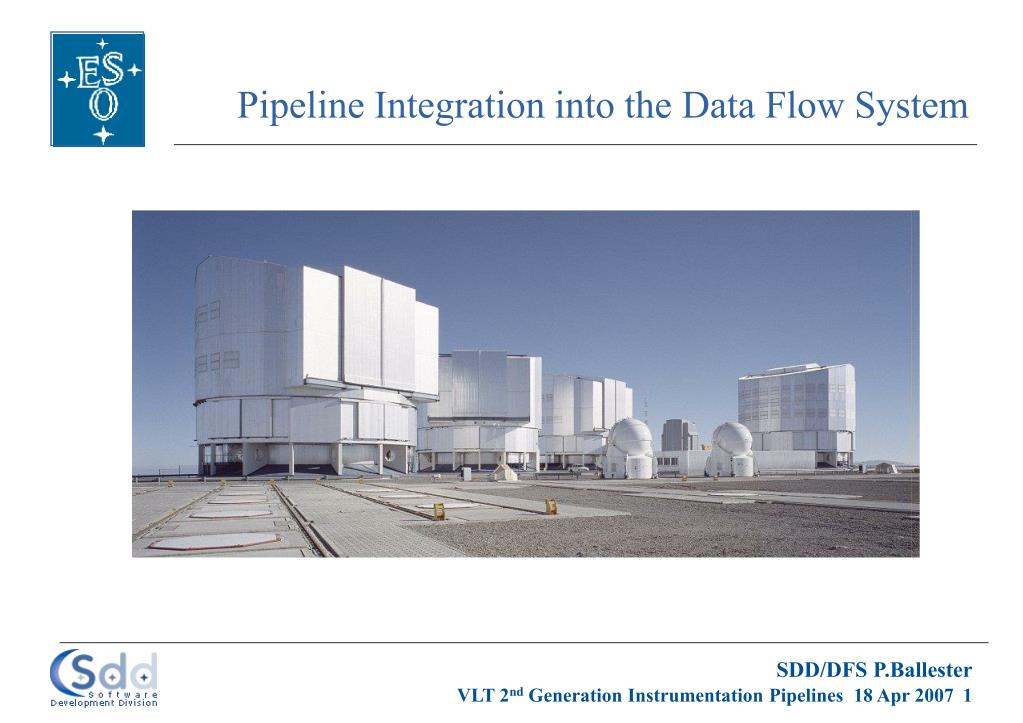
Pipeline Integration into the Data Flow System - slide 1
01 / 19Pipeline Integration into the Data Flow System
1 / 17

Télécharger la présentation

Pipeline Integration into the Data Flow System
Une image / un lien ci-dessous est fourni (tel quel) pour télécharger la présentation

Politique de téléchargement : le contenu du site vous est fourni TEL QUEL pour votre information et votre usage personnel ; il ne peut être vendu, concédé sous licence ni partagé sur d’autres sites sans l’accord de son auteur.Le contenu vous est fourni TEL QUEL, pour votre information et votre usage personnel uniquement. Téléchargez la présentation en cliquant sur ce lien. Lors du téléchargement, si vous ne parvenez pas à télécharger une présentation, l’éditeur a peut-être supprimé le fichier de son serveur.Pendant le téléchargement, si vous ne parvenez pas à obtenir une présentation, le fichier a peut-être été supprimé par l’éditeur.

F I N

Plus de contenu associé

Transcription de la présentation
  1. Pipeline Integration into the Data Flow System

  2. Pipeline Integration DICB/Archive Data Flow Operations Pipeline Library + Test Data Pipeline Team INS Commissioning Team Paranal Science Operations Public Release

  3. Talk Outline • From PDR to Commissioning • Raw Data/DICB Approval • Evaluation: Commissioning / SV • Release: Pipeline releases • Pipeline @ Paranal • Pipeline @ Garching • Maintenance: Pipeline updates and evolution

  4. DFS Deliverables: Template Schedule

  5. DFS Deliverables: Template Schedule (cont’d)

  6. Data Flow Systems Department Front-End Pipelines/CPL Back-End SAMPO P.Ballester K.Banse S.Castro L.De Bilbao A.Gabasch C.Izzo Y.Jung J.Larsen H.Lorch L.Lundin A.Modigliani R.Palsa J.Vinther

  7. From PDR to Commissioning • PDR Preparation • Reuse existing documents as templates • FDR Preparation • Prototype data reduction algorithms (test and simulated data) • Pipeline is template based, • but do we need any additional off-line processing? • Data combination, interactive processing • Coding starts only after the FDR • PAE and Commissioning • Validated data reduction algorithms (test and simulated data) • Explore alternative calibration methods

  8. DICB Approval • DICB Validation • No redefinition of existing keywords (database at www.eso.org/dicb) • Keyword names should not be too long • Avoid underscores and special characters • DPR Keyword Values • Ideally, classification rules are only based on DPR keywords • Valid values are listed in the DICB 3.0 documents • Submit proposal to DICB by FDR before using new values • Multi-HDU files • Always the same structure of data for a given data type • Data extensions come first, auxiliary and optional tables afterward

  9. Association Maps

  10. OCA Rules if DPR.CATG=="CALIB" and DPR.TYPE=="LAMP,WAVE" then { DO.CLASS = "ARC_SPECTRUM"; RAW.TYPE = "WAVE"; } • CLASSIFICATION select execute(GI_WAVE_CALIBRATION) from inputFiles where RAW.TYPE=="WAVE“ group by TPL.START • ORGANIZATION action GI_WAVE_CALIBRATION { select file as MASTER_BIAS from calibFiles where PRO.CATG=="MASTER_BIAS" and inputFile.DET.WIN1.BINX==DET.WIN1.BINX; select file as GRATING_DATA from calibFiles where PRO.CATG=="GRATING_DATA" and inputFile.INS.GRAT.NAME==INS.GRAT.NAME; recipe giwavecalibration { } product mflat { PRO.CATG="MASTER_FLAT"; } } • ASSOCIATION

  11. OCA rules: Operational environments • Pipeline (ESO Observatory, Data Organiser) • On-the-fly data processing (event driven) • Template-based processing • Static calibration database (only certified products are used) • Quality Control (ESO Headquarters, ABbuilder) • Batch processing of complete data sets (all science and calibration data produced by one ESO instrument in one night) • Best available calibrations are used => data must be organized according to the Calibration Cascade • Science Archive (CalSelector) • Web-based association of calibration data (raw and reduced) to science data

  12. Pipelines @ Paranal On-Line Archive Sytem Archive Instrument Raw Data Shipping Raw data PIPELINE OFFLINE Processed data Further Analysis

  13. Control SW Display CIS CLIP Common Library for Image Processing CPL Pipelines DFS CLIP Modules

  14. Quality Control Log Files 12:21:51>-START GROUP / Start [AMBER] 12:21:51> ARCFILE = 'AMBER.2007-03-21T12:16:08.099.fits' [AMBER] 12:21:51> TELESCOP = 'NOT_SPECIFIED' / Telescope [AMBER] 12:21:51> INSTRUME = 'AMBER' / Instrument name [AMBER] 12:21:51> OBSERVER = 'UNKNOWN' / Observer name [AMBER] 12:21:51> PIPEFILE = 'p2vm.fits' / Filename of data product [AMBER] 12:21:51> INS GRAT1 NAME = 'GHR' / Grating common name. [AMBER] 12:21:51> INS GRAT1 RESOL = 527.778; / Encoder resolution [Enc/deg]. [AMBER] 12:21:51> INS GRAT1 WLEN = 2364.972; / Grating central wavelength [nm]. [AMBER] 12:21:51> INS GRAT1 ZORDER = 40319; / Grating zero order position [Enc]. [AMBER] 12:21:51> INS GRIS1 NAME = 'NAR_SLT' / OPTIi name. [AMBER] 12:21:51> INS GRIS2 NAME = '3T_K' / OPTIi name. [AMBER] 12:21:51> INS MODE = '3Tstd_High_K_1_2.365' / Instrument mode used. [AMBER] 12:21:51> PRO DID = 'ESO-VLT-DIC.PRO-1.15' / Data dictionary for PRO [AMBER] 12:21:51> PRO CATG = 'P2VM_REDUCED' / pipeline product category [AMBER] 12:21:51> PRO TYPE = 'REDUCED' / Product type [AMBER] 12:21:51> PRO REC1 ID = 'amber_p2vm' / Pipeline recipe (unique) identifier [AMBER] 12:21:51> PRO REC1 DRS ID = 'cpl-3.0' / Data Reduction System identifier [AMBER] 12:21:51> PRO REC1 PIPE ID = 'AMBER/2.3.2' / Pipeline (unique) identifier [AMBER] 12:21:51> PRO REC1 RAW1 NAME = 'AMBER.2007-03-21T12:13:38.479.fits' / File name of raw frame [AMBER] 12:21:51> PRO REC1 RAW1 CATG = 'AMBER_3WAVE' / Frame category of raw frame [AMBER] 12:21:51> PRO DATANCOM = 14; / Number of frames combined [AMBER] 12:21:51> PRO REC1 CAL1 NAME = 'FlatFieldMap.fits' / File name of calibration frame [AMBER] 12:21:51> PRO REC1 CAL1 CATG = 'AMBER_FLATFIELD' / Frame category of calibration frame [AMBER] 12:21:51> PRO REC1 PARAM1 NAME = 'dummy' / Name of recipe parameter [AMBER] 12:21:51> DET NTEL = 3; / Number of telescopes [AMBER] 12:21:51> QC P1 OFFSETY = 0.02; / Offset wavelength calibration [AMBER] 12:21:51> QC P2 OFFSETY = 0.05; / Offset wavelength calibration [AMBER] 12:21:51> QC P3 OFFSETY = 0.03; / Offset wavelength calibration [AMBER] 12:21:51>-STOP GROUP / Stop [AMBER]

  15. Pipeline @ Garching: QC • Main Tasks • Create master calibrations • Derive and trend QC parameters • Create science products (Service Mode) • Prepare data packages (Service Mode) • Pipelines & QC parameters: requirements & testing • Customers • Paranal Science Operations • ESO community (PIs, archive users) Home Page: www.eso.org/qc

  16. Pipeline @ Garching • Based on ABbuilder • For each night, create Association Blocks on calibration data • Process calib ABs • Certify calib products and move to products directory • Update Association Blocks with real products • create Association Blocks on science data • Process science ABs • Check science products and move to products directory • Split data by Program_ID and by Observing Block • Include associated calibration data

  17. Information by Instrument Similar pages for every VLT/VLTI instrument

  18. Public Releases • Timing • About SO1 + 4-6 months • Pipeline User Manual • Template structure • Installation Package • Internal Review • Release Home Page: www.eso.org/pipelines

  19. Pipeline Maintenance • DFS Tickets • Issued by PSO, DFO, INS, and the user community • Pipeline priority meetings • Bi-yearly meetings with representation of INS, DFO, PSO, SDD • General issues and for each instrument closed, in process, open tickets • Priority setting for further pipeline development • Instrument Evolution • Commissioning of new modes • Detector upgrades