Simple Harmonic Motion and Waves
Simple Harmonic Motion (SHM) describes oscillations back and forth along a path, with a classic example being an object on a spring. In SHM, the restoring force acts to return the object to its equilibrium position, following Hooke's Law (F = -kx). Key terms include displacement, amplitude, cycle, period, frequency, and energy storage in the system. The period of oscillation depends on mass and spring constant, while the small angle approximation allows for the simple pendulum to exhibit SHM. Explore these foundational principles for a deeper understanding of oscillatory systems.

Simple Harmonic Motion and Waves
E N D
Presentation Transcript
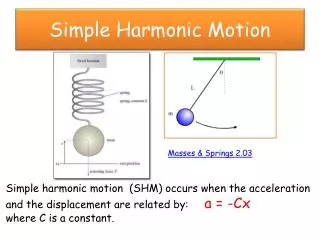
Simple Harmonic Motion When a vibration or an oscillation repeats itself, back and forth [to & fro] over the same path • Simplest is an object oscillating on the end of a coiled spring • Ignore the masses of the spring & ignore friction • When no force is exerted by the spring, its natural length is the equilibrium position (x=0)
Restoring Force • When the mass moves from equilibrium position, a force is exerted and acts in the direction of returning the mass to the equilibrium position • Hooke’s law: F = -kx
Terms • displacement—distance, x, from equilibrium point at any moment • amplitude—maximum displacement • cycle—complete to and fro; x = A to x = -A • period—T—time to complete one cycle • frequency—f—number of cycles per second • Hertz—unit of frequency; 1 Hertz = 1 cycle/ second; 1 Hz = 1 sec –1 • NOTE THAT T = 1/f and f = 1/T
SHO vs SHM • SHM—Simple Harmonic Motion is exhibited by any vibrating system for which Fr ∝ -kx • “Simple” means single frequency and “Harmonic” means sinusoidal • SHO—Simple Harmonic Oscillator; it’s what we call the above system that is exhibiting SHM.
Energy in the SHO • Since the force is NOT constant—the energy approach is much easier! • To strecth/compress a spring, Work must be done & E is stored (PE). • Recall that for a spring… PE = ½ kx2 • For a mass and spring system the total mechanical E = PE + KE or…. • E = ½ kx2 + ½ mv2
THE PERIOD AND SINUSOIDAL NATURE OF SHM • The period, T, of a SHO depends on m & k but NOT on amplitude. • f = 1/T
THE PERIOD AND SINUSOIDAL NATURE OF SHM • ω = φ/t (rad/s) • ω = 2 πf
Velocity in SHO depends on Position Only Where A is the max amplitude. Vmax = 2πAf = A(k/m)1/2
Acceleration • a = F/m = -kx/m = -(kA/m)cos ω t • Amax = kA/m
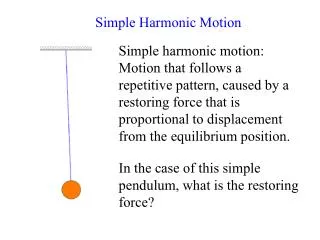
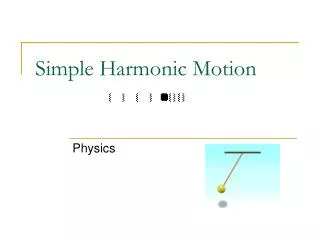
The Simple Pendulum A small object [bob] suspended from the end of a lightweight cord—ignore the mass of the cord relative to the bob. Swing it back and forth and it resembles simple harmonic motion—or does it?
The Simple Pendulum • The displacement along the arc is given by x = Lθ. Thus, if the restoring force is ∝ to x or to θ, it’s SHM. • Fr = -mg sin θ • Since F is ∝ to the sine of θ • and not θ, itself • it’s NOT SHM
BUT! • If we have a very small θ, then sin θ is very near θ when θ is in radians. • If θ is 15° or less the difference between θ and sinθ is less than 1% IF done in radians.
The Simple Pendulum • = 2π (L/g)1/2