Download
1 / 25
250 likes | 344 Vues
Learn how Canadian utilities manage water loss through benchmarking strategies. Compare, improve, and evolve water management practices to save resources and improve efficiency. Discover best practices and share experiences.

E N D
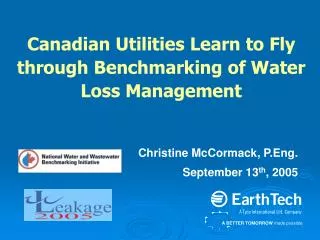
Canadian Utilities Learn to Fly through Benchmarking of Water Loss Management Christine McCormack, P.Eng. September 13th, 2005
Benchmarking Evolution • Introduction to NWWBI • Collecting PM data • Comparison of results • Water loss management strategies and best practices
How well are we doing? • How well do we compare • with similar organizations? • Are we getting value for money? • How can we improve? What is Benchmarking?
The Early Days • Pilot study in 1997 – NRC, four wastewater utilities & Earth Tech • Determine utility goals • Ensure apples-to-apples comparison through on-site data collection • Water Utilities joined in 2001
National Benchmarking 34Wastewater Utilities 32Water Utilities 15Stormwater Utilities
Water Loss in 2001 • “Unaccounted for water” • Many using PM “% of supply” • Adopted PM of m³/km/day of UFW • Leak detection primary strategy • Relevant to Reliable and Sustainable Goal
2000 UFW m³/km/day Min 55 L/conn/day Max 545 L/conn/day
Metric vs Process BM Metric Benchmarking Process Benchmarking • How to Close the Gap • Improved Knowledge • Improved Practices • Improved Processes • Identify Performance Gap: • How much • Where • When Management Commitment Employee Participation SUPERIOR PERFORMANCE
Water Loss Task Force • Conference calls • Breakout session at the Annual Workshop • Sharing of BPs: IWA Water Balance, InfraGuide, AWWA etc • Sharing of water loss reduction strategies
Water Loss in 2005 Non-Revenue Water • Transmission only systems PM: m³/km/day • Distribution & Integrated systems PM: L/connection/day
2003 NRW L/conn/day Min 105 L/conn/day Max 655 L/conn/day
Mission: Performance Improvement • Learn from others • Validate existing best practices • Report back on PII at Annual Workshop – solutions, problems, ideas • Group peer pressure
2005 Workshop - Abbotsford • Previously had separate fire and domestic line to ICI customers • New practice – combined domestic and fire line • Eliminates unauthorized use • Reduces O&M $
2005 Workshop - Calgary • Water demand management – reduce per capita demand by 33% by 2032 (no change in total consumption despite 50% growth) • Temporary DMAs, leak detection, main replacement, meter calibration
2005 Workshop - Peel • 7 pressure zones • 124 zone valves to maintain zone integrity = 248 dead end mains • Flushing required to maintain water quality • Pressure zone bypass (small f pipe and control valve) with minor constant flushing minimizes flushing volumes, reducing NRW and $ but maintaining water quality
Benefits of Water Loss BM • Compare water loss to peers • Share methodologies for estimating Water Balance components • Share Canadian experiences with water loss reduction strategies • Validate best practices by monitoring PM results
Conclusions • Canadian utilities now have data to manage their water loss • Water loss management has many strategies and applies to most of the utility goals • Next steps: Collect ILI data