Understanding Pressure, Compression, and Their Effects on Gases, Liquids, and Solids
This lesson explores the concept of pressure, defined as the force acting over an area. It examines compression, which leads to a decrease in volume, particularly in gases. Unlike gases, liquids and solids are nearly incompressible, and their volume remains constant under pressure. We discuss the relationship between pressure and kinetic energy, highlighting the potential for both explosions and implosions. Additionally, we review calculations of pressure using Newtons and square meters, emphasizing real-world applications like the BMX rider on metal sheeting.

Understanding Pressure, Compression, and Their Effects on Gases, Liquids, and Solids
E N D
Presentation Transcript
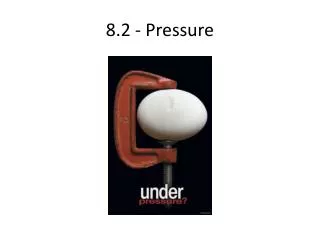
Pressure Pressure – the amount of force acting over a given area on an object.
Compression Compression – a decrease in volume because of a force. Why do you think the volume decreases? Shouldn’t it stay the same??
Gases are Compressible (con’t) Some uses for compressed gases:
Pressure and Kinetic Energy in Gases • Pressure can cause the particles energyto increase, which makes the particles move faster. • This can cause explosions!!
Pressure and Kinetic Energy in Gases (con’t) • Pressure can also cause implosions!!! • An implosion is a collapse inward.
Liquids and Solids are VERY Difficult to Compress • The volume does NOT change much in liquids and solids. Instead, the force is passed on to the particles directly. • This makes solids and liquidsincompressible.
Compression and Deformation • Solids can also appear compressed when they are deformed. Deformation – a change of shape without being forced into a smaller volume.
Comparing Pressure (con’t) UNITS: Force – N (Newton) Area - m² (square metres, or SQUAREA!!) Thus, Pressure is , or simply, Pa (Pascal) NOTE: 1 Pa is VERY small, so it is more common to see kPa (kiloPascal).
Calculating Pressure You can calculate the pressure an object exerts on a surface if you know its weight and the dimensions of the surface Example: • A BMX rider and bike weigh 1200 N. They are on a piece of sheet metal that is 1.0 m by 2.0 m. How much pressure does the sheet metal exert on the ground? P = P = P = P = P= 600 Pa
The Diving Bell • Why do you think the balloon shrinks??