
lab 5 con
E N D
Presentation Transcript
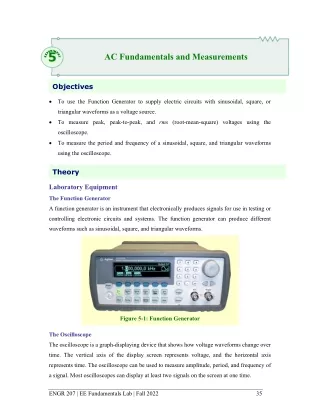
5 AC Fundamentals and Measurements Objectives To use the Function Generator to supply electric circuits with sinusoidal, square, or triangular waveforms as a voltage source. To measure peak, peak-to-peak, and rms (root-mean-square) voltages using the oscilloscope. To measure the period and frequency of a sinusoidal, square, and triangular waveforms using the oscilloscope. Theory Laboratory Equipment The Function Generator A function generator is an instrument that electronically produces signals for use in testing or controlling electronic circuits and systems. The function generator can produce different waveforms such as sinusoidal, square, and triangular waveforms. Figure 5-1: Function Generator The Oscilloscope The oscilloscope is a graph-displaying device that shows how voltage waveforms change over time. The vertical axis of the display screen represents voltage, and the horizontal axis represents time. The oscilloscope can be used to measure amplitude, period, and frequency of a signal. Most oscilloscopes can display at least two signals on the screen at one time. ENGR 207 | EE Fundamentals Lab | Fall 2022 35
Figure 5-2: Digital-Storage-Oscilloscope (DSO) The Sinusoidal Waveform The sinusoidal waveform or sine wave is the fundamental type of alternating current (ac) and alternating voltage. It is also referred to as a sinusoidal wave or, simply, sinusoid. Figure 5-3: Graph of one cycle of a sine wave A sine wave changes polarity at its zero value; that is, it alternates between positive and negative values. When the voltage changes polarity, the current correspondingly changes direction as indicated. Period of a Sinusoidal Waveform The time required for a sine wave to complete one full cycle is called the period (?). Figure 5-4: Graph of one cycle of a sinusoidal waveform ENGR 207 | EE Fundamentals Lab | Fall 2022 36
Measurement of the period Figure 5-5: Measurement of the Period Frequency of a Sinusoidal Waveform The more cycles completed in one second, the higher the frequency. Frequency (?) is measured ⁄ . in units of hertz. One hertz (Hz) is equivalent to one cycle per second, ? ? 1 ? Lower frequency: fewer cycles per second. Figure 5-6: Frequency of a Sinusoidal Waveform Higher frequency: more cycles per second. Non-Sinusoidal Waveforms A square waveform is a pulse waveform with a duty cycle of 50%. Thus, the pulse width is equal to one-half of the period. Figure 5-7: Square Waveform ENGR 207 | EE Fundamentals Lab | Fall 2022 37
A triangular waveform is composed of positive-going and negative-going ramps having equal slopes. The period of this waveform is measured from one peak to the next corresponding peak. Figure 5-8: Triangular Waveform Peak Value The peak value of a sine wave is the value of voltage (or current) at the positive or the negative maximum (peak) with respect to zero. Since the positive and negative peak values are equal in magnitude, a sine wave is characterized by a single peak value. For a given sine wave, the peak value is constant and is represented by ?? or??. The peak value is also called the amplitude. Figure 5-9: Peak Value Peak-to-Peak Value The peak-to-peak value of a sine wave is the voltage or current from the positive peak to the negative peak. It is always twice the peak value. Peak-to-peak voltage or current values are represented by ??? or ???. Figure 5-10: Peak-to-Peak Value ENGR 207 | EE Fundamentals Lab | Fall 2022 38
RMS (Root-Mean-Square) Value The root-mean-square, or rms value for short, is the (square) root of the mean (or average) of the square of the periodic signal. For any periodic function ???? in general, the rms value is given by, ? ????? ?1 (1) ?? ???? ? Most AC voltmeters display rms voltage. The 240 ? the wall outlet is an rms value. The rms value is also referred to as the effective value. RMS Value for Sinusoidal, Square, and Triangular Waveforms For a sinusoidal waveform, the rms value is ?? √2? ??? 2√2 ????? (2) For a triangular waveform, the rms value is ?? √3? ??? 2√3 ????? (3) For a square waveform, the rms value is ????? ?????? (4) 2 Analysis of AC Resistive Circuits If a sinusoidal voltage is applied across a resistor, there is a sinusoidal current. The current is zero when the voltage is zero and is maximum when the voltage is maximum. When the voltage changes polarity, the current reverses direction. As a result, the voltage and current are said to be in phase with each other. When you use Ohm’s law in ac circuits, remember that both the voltage and the current must be expressed consistently, that is, both as peak values, both as rms values, and so on. Kirchhoff’s voltage and current laws apply to AC circuits as well as to DC circuits. The source voltage is the sum of all the voltage drops across the resistors, just as in a DC circuit. + + = Vs V1 V2 V3 R1 R2 R3 Vs Figure 5-11: KVL of a resistive circuit with sinusoidal source ENGR 207 | EE Fundamentals Lab | Fall 2022 39
OrCAD Simulation (Pre-Lab) Simulate the circuit shown in Figure 5-12 in OrCAD with the following steps. ? Figure 5-12: Circuit Diagram Part I: Sinusoidal Waveform 1. Start OrCAD. Add four resistors;??? 2 ?Ω ; ??? ??? 10 ?Ω ; and ??? 1 ?Ω. Add a 2 ??? sinusoidal voltage source (????) as follows: 2. 3. Parameter VOFF Description Offset voltage (volts); Value 0 ?? 2 ??? = VAMPL = Amplitude (volts); FREQ = Frequency (hertz). Note: the voltage level of the waveform will be given by your lab instructor. 4. Add the ground and connect the components together with wires. 5. Simulate the circuit using ‘Time Domain (Transient)’ analysis as follows: Run To Time : Include the first two cycles. 1 ??. Maximum Step Size : ☑ Skip initial transient bias point calculation (SKIPBP). Plot the node voltages ?? and ??using the ‘Voltage Probe’, and plot ???? ??? ?? using the ‘Differential Voltage Probe’. 6. Measure the peak-to-peak voltages for ????, ????, and ????? using the ‘cursor’ and 7. determine the period ?. Calculate ?????? from ????? using the rms formula. 8. ⁄ Calculate ???? using Ohm’s law; ????? ???????? 9. . ENGR 207 | EE Fundamentals Lab | Fall 2022 40
Part II: Square Waveform 10.Change the source to a 2 ??? square voltage source (??????) as follows, Parameter V1 Description Initial value (volts); Value ??? ?? 0 1 ?? 1 ?? 0.5 ? ? ? = V2 = Pulsed value (volts); TD = Delay time (seconds); TR = Rise time (seconds); TF = Fall time (seconds); PW = Pulse width (seconds); PER = Period (seconds). Note: the voltage level of the waveform will be given by your lab instructor. 11.Redo steps (6) to (9) for the square waveform. Part III: Triangular Waveform 12.Change the parameters of (??????) to get a 2 ??? triangular voltage as follows, Parameter V1 Description Initial value (volts); Value ??? ?? 0 0.5 ? ? 0.5 ? ? 1 ?? ? = V2 = Pulsed value (volts); TD = Delay time (seconds); TR = Rise time (seconds); TF = Fall time (seconds); PW = Pulse width (seconds); PER = Period (seconds). Note: the voltage level of the waveform will be given by your lab instructor. 13.Redo steps (6) to (9) for the triangular waveform. 14.Complete the simulated values in Tables 5-1, 5-2, and 5-3 in the datasheet. ENGR 207 | EE Fundamentals Lab | Fall 2022 41
Experimental Work Equipment: 1. 2. Function Generator (FG). Digital-Storage-Oscilloscope (DSO). 3. 4. Digital multimeter (DMM). Breadboard. 5. Discrete Resistors. Procedure: 1. Select four resistors as indicated in the prelab and connect the circuit in Figure 5-12 on the breadboard. Part I: Sinusoidal Waveform Set the Function Generator (FG) to produce a 2 ??? sinusoidal waveform with the 2. required voltage level. 3. Turn on the oscilloscope and load the default oscilloscope setup. Connect channel 1 probe on the oscilloscope to node ‘?’, and channel 2 probe to node 4. ‘?’. Use auto-scale. 5. Adjust the horizontal scale (time per division), horizontal position, vertical scale (voltage per division) and vertical position as suitable. Measure the period (?) of the waveform, the node voltages ???? and ????. 6. Use the Math function to display ???? ??? ?? and measure ?????. 7. Use the ac voltmeter function in the digital multimeter (DMM) to measure ??????. Use the ac ammeter function in the digital multimeter (DMM) to measure ????. Part II: Square Waveform 8. 9. 10.Adjust the source waveform from the Function Generator to produce a square waveform with the same frequency and voltage level. 11.Repeat the steps 6 to 9. Part III: Triangular Waveform 12.Adjust the source waveform from the Function Generator to produce a triangular waveform with the same frequency and voltage level. 13.Repeat the steps 6 to 9. 14.Complete the measured values in Tables 5-1, 5-2, and 5-3 in the datasheet. ENGR 207 | EE Fundamentals Lab | Fall 2022 42
Datasheet Part I: Sinusoidal Waveform Table 5-1 Measurements for Sinusoidal Waveform ??????? ??????? ???????? ????? ????????????????? Sinusoidal Simulated Measured Part II: Square Waveform Table 5-2 Measurements for Square Waveform ??????? ??????? ???????? ????? ????????????????? Square Simulated Measured Part III: Triangular Waveform Table 5-3 Measurements for Triangular Waveform ??????? ??????? ???????? ????? ????????????????? Triangular Simulated Measured ENGR 207 | EE Fundamentals Lab | Fall 2022 43
Post Lab Questions Answer the following questions regarding the lab and write your answers in the dissection and analysis part of your lab report. For the following questions: Use the value of ?? as in your lab experiment. Show your steps in your calculations and use drawn circuit schematics if required. Q1: Use the node voltages ??, ??, and ?? to find the voltage across each resistor. Use the simulated values since they are more accurate than the measured. It does not matter if the results are for sinusoidal, square, or triangular waveforms since the peak-to-peak values are the same for all of them as should you be noticed! ?????? ?????? ?????? ?????? Q2: Use the peak-to-peak voltage in Q1 and convert them to peak and rms for sinusoidal, square, triangular waveforms. ?????? ?????? ?????? ?????? Level Type peak-to-peak peak RMS Sinusoidal RMS Square RMS Triangular ENGR 207 | EE Fundamentals Lab | Fall 2022 44